
Join Our JEE Preparation Group
Prep with like-minded aspirants; Get access to free daily tests and study material.
Sign in
Please select an account to continue using cracku.in
↓ →
Join Our JEE Preparation Group
Prep with like-minded aspirants; Get access to free daily tests and study material.
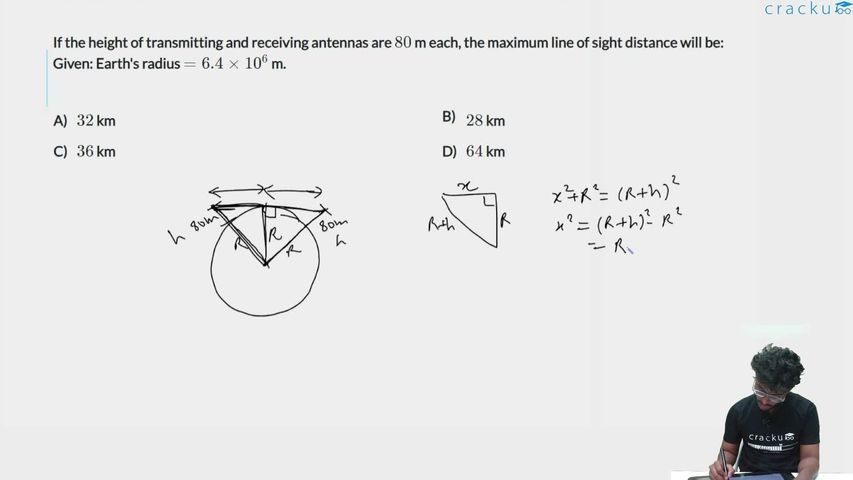
If the height of transmitting and receiving antennas are $$80$$ m each, the maximum line of sight distance will be:
Given: Earth's radius $$= 6.4 \times 10^6$$ m.
The maximum line-of-sight distance between a transmitter and receiver is given by $$d = \sqrt{2Rh_T} + \sqrt{2Rh_R}$$, where $$R$$ is the Earth's radius and $$h_T, h_R$$ are the heights of the transmitting and receiving antennas respectively.
Since both antennas have the same height $$h_T = h_R = 80$$ m, the formula gives $$d = 2\sqrt{2Rh}$$. Substituting $$R = 6.4 \times 10^6$$ m and $$h = 80$$ m: $$d = 2\sqrt{2 \times 6.4 \times 10^6 \times 80} = 2\sqrt{1024 \times 10^6} = 2 \times 32 \times 10^3 = 64{,}000$$ m $$= 64$$ km.
The maximum line-of-sight distance is $$\boxed{64 \text{ km}}$$, which is option (D).
Was this solution helpful?
Click on the Email ☝️ to Watch the Video Solution
Create a FREE account and get:
_1.webp)

Educational materials for JEE preparation

Ask our AI anything

AI can make mistakes. Please verify important information.
AI can make mistakes. Please verify important information.
