
Join Our JEE Preparation Group
Prep with like-minded aspirants; Get access to free daily tests and study material.
Sign in
Please select an account to continue using cracku.in
↓ →
Join Our JEE Preparation Group
Prep with like-minded aspirants; Get access to free daily tests and study material.
As shown in the figures, a uniform rod $$OO'$$ of length $$l$$ is hinged at the point $$O$$ and held in place vertically between two walls using two massless springs of same spring constant. The springs are connected at the midpoint and at the top-end ($$O'$$) of the rod, as shown in Fig. 1 and the rod is made to oscillate by a small angular displacement. The frequency of oscillation of the rod is $$f_1$$. On the other hand, if both the springs are connected at the midpoint of the rod, as shown in Fig. 2 and the rod is made to oscillate by a small angular displacement, then the frequency of oscillation is $$f_2$$.
Ignoring gravity and assuming motion only in the plane of the diagram, the value of $$\frac{f_1}{f_2}$$ is:
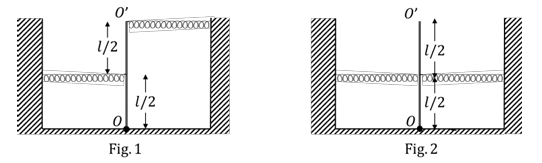
Let the mass of the rod be $$m$$ and its length be $$l$$. It oscillates about the fixed hinge $$O$$ with a small angular displacement $$\theta$$ (taken positive for a clockwise rotation). Gravity is ignored, so only the springs give the restoring torque.
1. Moment of inertia about the hinge
For a uniform rod of length $$l$$ about one end,
$$I = \frac{1}{3} m l^{2}$$
2. Extension produced in a spring connected at distance $$r$$ from the hinge
When the rod rotates through a small angle $$\theta$$, every point at a distance $$r$$ from the hinge moves through an arc of length $$r\theta$$ perpendicular to the rod’s original position.
Hence the linear extension (or compression) of a spring attached at that point is also $$r\theta.$$
3. Restoring torque of one spring
Spring force $$F = k \,(r\theta) \quad\Rightarrow\quad$$ Torque about $$O: \quad \tau = F \cdot r = k \, r^{2}\theta.$$
Therefore each spring contributes a restoring torque equal to $$k r^{2}\theta.$$
4. Angular equation of motion
Sum of restoring torques $$= k\,(r_1^{2}+r_2^{2})\,\theta.$$
Hence
$$I\,\ddot{\theta} + k\,(r_1^{2}+r_2^{2})\,\theta = 0\; \Longrightarrow\; \omega = \sqrt{\dfrac{k\,(r_1^{2}+r_2^{2})}{I}}.$$
The linear frequency is $$f = \dfrac{\omega}{2\pi},$$ so the ratio $$f_1/f_2$$ equals the ratio $$\omega_1/\omega_2.$$
Case 1: (Fig. 1)
Springs at $$r_1=l/2$$ and $$r_2=l$$
$$r_1^{2}+r_2^{2} = \left(\frac{l}{2}\right)^{2} + l^{2} = \frac{l^{2}}{4}+l^{2} = \frac{5}{4}l^{2}.$$
$$\displaystyle \omega_1 = \sqrt{\dfrac{k\left(\tfrac{5}{4}l^{2}\right)}{I}}.$$
Case 2: (Fig. 2)
Both springs at $$r_1=r_2=l/2$$
$$r_1^{2}+r_2^{2} = 2\left(\frac{l}{2}\right)^{2} = 2\left(\frac{l^{2}}{4}\right)=\frac{l^{2}}{2}.$$
$$\displaystyle \omega_2 = \sqrt{\dfrac{k\left(\tfrac{l^{2}}{2}\right)}{I}}.$$
5. Ratio of frequencies
$$\frac{f_1}{f_2}=\frac{\omega_1}{\omega_2}=
\sqrt{\dfrac{k\left(\tfrac{5}{4}l^{2}\right)}{I}} \;\Bigg/\; \sqrt{\dfrac{k\left(\tfrac{l^{2}}{2}\right)}{I}}
= \sqrt{\dfrac{\tfrac{5}{4}l^{2}}{\tfrac{l^{2}}{2}}}
= \sqrt{\dfrac{5}{4}\cdot\dfrac{2}{1}}
= \sqrt{\dfrac{10}{4}}
= \sqrt{\dfrac{5}{2}}.$$
Hence $$\displaystyle \frac{f_1}{f_2} = \sqrt{\frac{5}{2}}.$$ Option C is correct.
Was this solution helpful?
Create a FREE account and get:
_1.webp)

Educational materials for JEE preparation

Ask our AI anything

AI can make mistakes. Please verify important information.
AI can make mistakes. Please verify important information.
