
Join Our JEE Preparation Group
Prep with like-minded aspirants; Get access to free daily tests and study material.
Sign in
Please select an account to continue using cracku.in
↓ →
Join Our JEE Preparation Group
Prep with like-minded aspirants; Get access to free daily tests and study material.
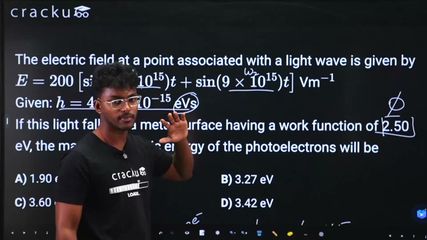
The electric field at a point associated with a light wave is given by
$$E = 200\left[\sin(6 \times 10^{15})t + \sin(9 \times 10^{15})t\right]$$ Vm$$^{-1}$$
Given: $$h = 4.14 \times 10^{-15}$$ eVs
If this light falls on a metal surface having a work function of 2.50 eV, the maximum kinetic energy of the photoelectrons will be
We are given the electric field of a light wave and need to find the maximum kinetic energy of photoelectrons. The electric field is: $$E = 200\left[\sin(6 \times 10^{15})t + \sin(9 \times 10^{15})t\right] \text{ Vm}^{-1}$$ so the angular frequencies are $$\omega_1 = 6 \times 10^{15}$$ rad/s and $$\omega_2 = 9 \times 10^{15}$$ rad/s, giving corresponding frequencies $$\nu_1 = \frac{\omega_1}{2\pi} = \frac{6 \times 10^{15}}{2\pi}$$ and $$\nu_2 = \frac{\omega_2}{2\pi} = \frac{9 \times 10^{15}}{2\pi}$$.
For maximum kinetic energy, we use the photon with the highest frequency, which is $$\nu_2$$. The photon energy is $$E_{\text{photon}} = h\nu_2 = h \times \frac{\omega_2}{2\pi} = \frac{h\omega_2}{2\pi}$$. Using $$\hbar = \frac{h}{2\pi}$$, this becomes $$E_{\text{photon}} = \hbar \omega_2 = \frac{4.14 \times 10^{-15}}{2\pi} \times 9 \times 10^{15} = \frac{4.14 \times 9}{2\pi} = \frac{37.26}{6.2832} = 5.93 \text{ eV}$$.
Applying Einstein's photoelectric equation, $$KE_{\max} = E_{\text{photon}} - \phi$$, we get $$KE_{\max} = 5.93 - 2.50 = 3.43 \approx 3.42 \text{ eV}$$. The answer is Option D: 3.42 eV.
Was this solution helpful?
Click on the Email ☝️ to Watch the Video Solution
Create a FREE account and get:
_1.webp)

Educational materials for JEE preparation

Ask our AI anything

AI can make mistakes. Please verify important information.
AI can make mistakes. Please verify important information.
