
Join Our JEE Preparation Group
Prep with like-minded aspirants; Get access to free daily tests and study material.
Sign in
Please select an account to continue using cracku.in
↓ →
Join Our JEE Preparation Group
Prep with like-minded aspirants; Get access to free daily tests and study material.
An electric dipole is formed by two charges $$+q$$ and $$-q$$ located in xy-plane at (0, 2) mm and (0, -2) mm, respectively, as shown in the figure. The electric potential at point P(100, 100) mm due to the dipole is $$V_0$$. The charges $$+q$$ and $$-q$$ are then moved to the points (-1, 2) mm and (1, -2) mm, respectively. What is the value of electric potential at P due to the new dipole?
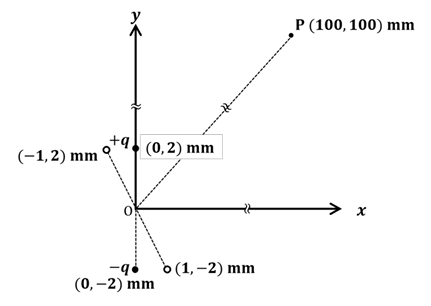
The point $$P(100,100)$$ mm is nearly $$\sqrt{(100)^2+(100)^2}=100\sqrt2\;{\rm mm}\approx141\;{\rm mm}$$ away from the origin, whereas the two charges are only a few millimetres apart. Hence $$r\gg d$$ and the far-field (dipole) approximation is valid.
For a dipole whose moment is $$\mathbf p$$ and for an observation point with position unit vector $$\hat{\mathbf r}$$ (drawn from the centre of the dipole to the point), the electric potential is
$$V=\frac{1}{4\pi\varepsilon_0}\,\frac{\mathbf p\cdot \hat{\mathbf r}}{r^{2}}\;.$$
This expression shows that for the \emph{same} observation point $$P$$ the ratio of two potentials is simply the ratio of the scalar products $$\mathbf p\cdot\hat{\mathbf r}$$, because $$r$$ and $$4\pi\varepsilon_0$$ remain unchanged.
Step 1 : Unit vector from origin to P
The position vector of $$P$$ is $$\mathbf r=(100,\,100)\;{\rm mm}$$.
Magnitude: $$r=100\sqrt2\;{\rm mm}$$.
Hence $$\hat{\mathbf r}= \left(\frac{1}{\sqrt2},\;\frac{1}{\sqrt2}\right).$$
Step 2 : Dipole moment before shifting the charges
Negative charge $$-q$$ is at $$(0,-2)$$ mm, positive charge $$+q$$ at $$(0,2)$$ mm.
Vector from $$-q$$ to $$+q$$: $$\mathbf d=(0,\,4)\;{\rm mm}$$.
Dipole moment: $$\mathbf p = q\,\mathbf d = (0,\,4q).$$
Dot product with $$\hat{\mathbf r}$$:
$$\mathbf p\cdot\hat{\mathbf r}=0\cdot\frac1{\sqrt2}+4q\cdot\frac1{\sqrt2}=\frac{4q}{\sqrt2}=2\sqrt2\,q.$$
Therefore the initial potential is
$$V_0=\frac{1}{4\pi\varepsilon_0}\,
\frac{2\sqrt2\,q}{r^{2}}.$$
Step 3 : Dipole moment after shifting the charges
Negative charge $$-q$$ moves to $$(1,-2)$$ mm, positive charge $$+q$$ to $$(-1,2)$$ mm.
Vector from $$-q$$ to $$+q$$: $$\mathbf d' = (-1-1,\;2-(-2)) = (-2,\,4)\;{\rm mm}.$$
Dipole moment: $$\mathbf p' = q\,\mathbf d' = (-2q,\,4q).$$
Dot product with $$\hat{\mathbf r}$$:
$$\mathbf p'\cdot\hat{\mathbf r}=(-2q)\cdot\frac1{\sqrt2}+4q\cdot\frac1{\sqrt2}
=\frac{-2q+4q}{\sqrt2}
=\frac{2q}{\sqrt2}
=\sqrt2\,q.$$
Thus the new potential at $$P$$ is
$$V'=\frac{1}{4\pi\varepsilon_0}\,
\frac{\sqrt2\,q}{r^{2}}.$$
Step 4 : Ratio of the two potentials
$$\frac{V'}{V_0}=\frac{\sqrt2\,q}{2\sqrt2\,q}=\frac12.$$
Hence $$V' = \dfrac{V_0}{2}.$$
Option B which is: $$V_0/2$$
Was this solution helpful?
Create a FREE account and get:
_1.webp)

Educational materials for JEE preparation

Ask our AI anything

AI can make mistakes. Please verify important information.
AI can make mistakes. Please verify important information.
