
Join Our JEE Preparation Group
Prep with like-minded aspirants; Get access to free daily tests and study material.
Sign in
Please select an account to continue using cracku.in
↓ →
Join Our JEE Preparation Group
Prep with like-minded aspirants; Get access to free daily tests and study material.
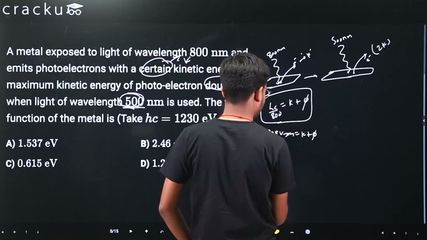
A metal exposed to light of wavelength $$800 \text{ nm}$$ and emits photoelectrons with a certain kinetic energy. The maximum kinetic energy of photo-electron doubles when light of wavelength $$500 \text{ nm}$$ is used. The work function of the metal is (Take $$hc = 1230 \text{ eV nm}$$).
A metal is exposed to light of wavelengths $$800 \text{ nm}$$ and $$500 \text{nm}$$. The maximum kinetic energy doubles when the wavelength changes from 800 nm to 500 nm. Given $$hc = 1230 \text{ eV nm}$$.
Applying the photoelectric equation for both wavelengths yields $$KE_1 = \frac{hc}{\lambda_1} - \phi = \frac{1230}{800} - \phi$$ and $$KE_2 = \frac{hc}{\lambda_2} - \phi = \frac{1230}{500} - \phi$$.
Using the condition that $$KE_2 = 2 \times KE_1$$ leads to the equation $$\frac{1230}{500} - \phi = 2\left(\frac{1230}{800} - \phi\right)$$, or in numeric form $$2.46 - \phi = 2(1.5375 - \phi)$$, which simplifies further to $$2.46 - \phi = 3.075 - 2\phi$$.
Solving for $$\phi$$ in $$2.46 - \phi = 3.075 - 2\phi$$ gives $$\phi = 0.615 \text{ eV}$$.
Hence, the correct answer is Option C.
Was this solution helpful?
Click on the Email ☝️ to Watch the Video Solution
Create a FREE account and get:
_1.webp)

Educational materials for JEE preparation

Ask our AI anything

AI can make mistakes. Please verify important information.
AI can make mistakes. Please verify important information.
