
Join Our JEE Preparation Group
Prep with like-minded aspirants; Get access to free daily tests and study material.
Sign in
Please select an account to continue using cracku.in
↓ →
Join Our JEE Preparation Group
Prep with like-minded aspirants; Get access to free daily tests and study material.
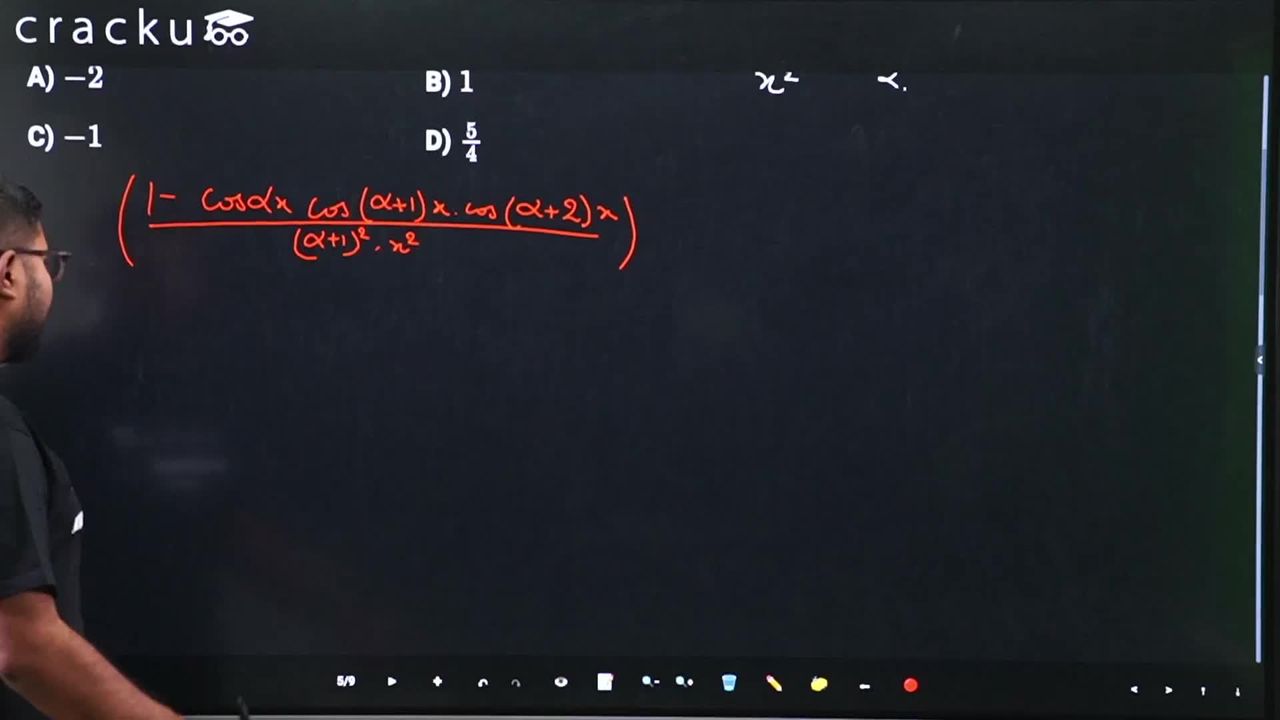
The product of all values of $$\alpha$$, for which $$\displaystyle\lim_{x \to 0} \left(\frac{1 - \cos(\alpha x) \cos((\alpha+1)x) \cos((\alpha+2)x)}{\sin^2((\alpha+1)x)}\right) = 2$$ is :
To solve this limit efficiently, we use the standard limit formula $$\lim_{x \to 0} \frac{1 - \cos(kx)}{x^2} = \frac{k^2}{2}$$.
First, let's normalize the denominator. Since $$\sin(kx) \approx kx$$ as $$x \to 0$$:
$$\sin^2((\alpha + 1)x) \approx (\alpha + 1)^2 x^2$$
Let $$k_1 = \alpha$$, $$k_2 = \alpha+1$$, and $$k_3 = \alpha+2$$. The numerator is $$1 - \cos(k_1x)\cos(k_2x)\cos(k_3x)$$.
Using the expansion $$\cos(kx) \approx 1 - \frac{k^2x^2}{2}$$, the product becomes:
$$\left(1 - \frac{k_1^2x^2}{2}\right)\left(1 - \frac{k_2^2x^2}{2}\right)\left(1 - \frac{k_3^2x^2}{2}\right) \approx 1 - \frac{(k_1^2 + k_2^2 + k_3^2)x^2}{2}$$
(Ignoring $$x^4$$ and higher terms as they vanish in the limit).
The numerator simplifies to:
$$1 - \left(1 - \frac{(k_1^2 + k_2^2 + k_3^2)x^2}{2}\right) = \frac{(k_1^2 + k_2^2 + k_3^2)x^2}{2}$$
The limit is given as 2:
$$\lim_{x \to 0} \frac{\frac{(k_1^2 + k_2^2 + k_3^2)x^2}{2}}{(\alpha + 1)^2 x^2} = 2$$
$$\frac{\alpha^2 + (\alpha+1)^2 + (\alpha+2)^2}{2(\alpha+1)^2} = 2$$
Expand the numerator:
$$\alpha^2 + \alpha^2 + 2\alpha + 1 + \alpha^2 + 4\alpha + 4 = 4(\alpha+1)^2$$
$$3\alpha^2 + 6\alpha + 5 = 4(\alpha^2 + 2\alpha + 1)$$
$$3\alpha^2 + 6\alpha + 5 = 4\alpha^2 + 8\alpha + 4$$
Rearrange into a quadratic equation:
$$\alpha^2 + 2\alpha - 1 = 0$$
For a quadratic equation $$ax^2 + bx + c = 0$$, the product of the roots is $$\frac{c}{a}$$.
Here, $$a = 1$$ and $$c = -1$$.
$$\text{Product of } \alpha = \frac{-1}{1} = -1$$
Correct Answer: C (-1)
Was this solution helpful?
Click on the Email ☝️ to Watch the Video Solution
Create a FREE account and get:
_1.webp)

Educational materials for JEE preparation

Ask our AI anything

AI can make mistakes. Please verify important information.
AI can make mistakes. Please verify important information.


