
Join Our JEE Preparation Group
Prep with like-minded aspirants; Get access to free daily tests and study material.
Sign in
Please select an account to continue using cracku.in
↓ →
Join Our JEE Preparation Group
Prep with like-minded aspirants; Get access to free daily tests and study material.
The equation $$\lambda = \frac{1.227}{x}$$ nm can be used to find the de-Broglie wavelength of an electron. In this equation $$x$$ stands for:
Where, $$m$$ = mass of electron, $$P$$ = momentum of electron, $$K$$ = Kinetic energy of electron, $$V$$ = Accelerating potential in volts for electron
We need to identify what $$x$$ represents in the de-Broglie wavelength equation $$\lambda = \frac{1.227}{\sqrt{x}}$$ nm.
Since an electron is accelerated through a potential difference $$V$$, its kinetic energy is $$K = eV$$, and its de-Broglie wavelength is given by $$\lambda = \frac{h}{\sqrt{2mK}} = \frac{h}{\sqrt{2meV}}$$.
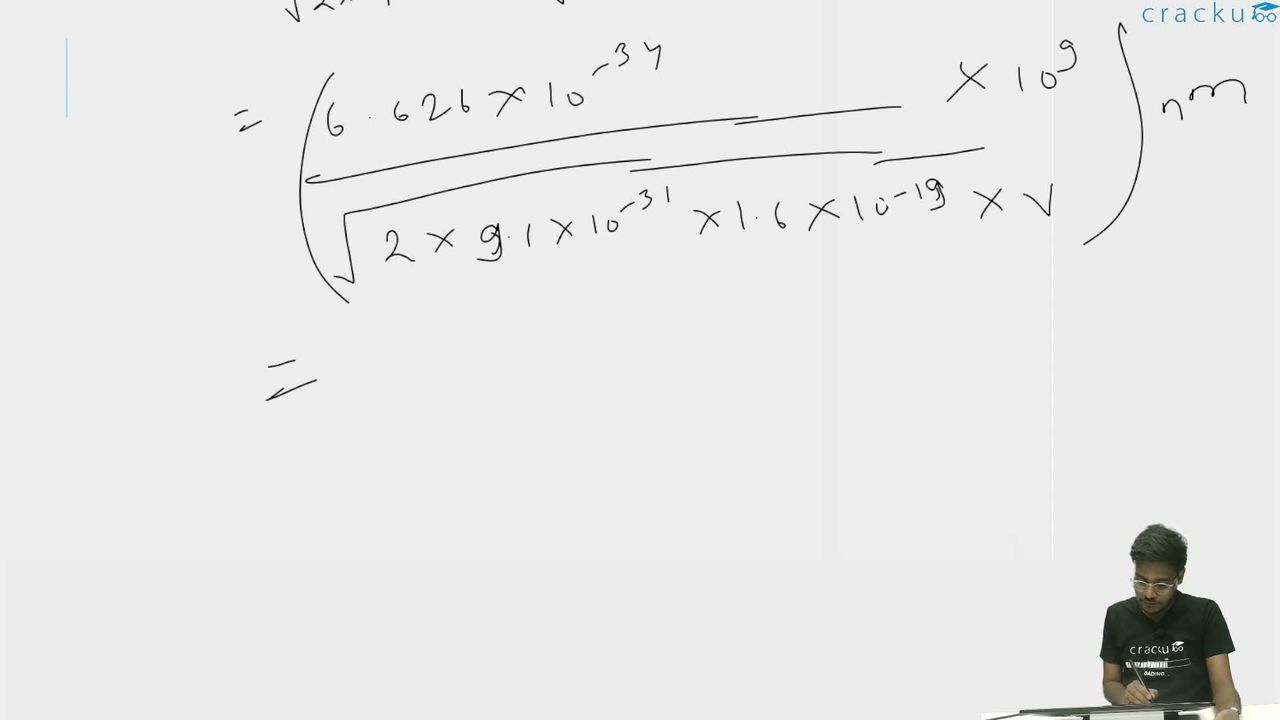
Substituting numerical values, we have $$\lambda = \frac{6.626 \times 10^{-34}}{\sqrt{2 \times 9.1 \times 10^{-31} \times 1.6 \times 10^{-19} \times V}} = \frac{6.626 \times 10^{-34}}{\sqrt{2.912 \times 10^{-49} \times V}} = \frac{6.626 \times 10^{-34}}{5.396 \times 10^{-25} \times \sqrt{V}} = \frac{1.227 \times 10^{-9}}{\sqrt{V}} \text{ m} = \frac{1.227}{\sqrt{V}} \text{ nm}.$$
From the above expression, comparing with $$\lambda = \frac{1.227}{\sqrt{x}}$$ nm shows that $$x = V$$, the accelerating potential in volts.
Therefore, among the given options, the choice $$\sqrt{V}$$ corresponds to $$x = V$$ (since $$\sqrt{x} = \sqrt{V}$$), making Option D the correct answer.
Note: The option $$\sqrt{V}$$ represents that $$x$$ stands for $$V$$ (accelerating potential in volts), and the denominator is $$\sqrt{V}$$.
Was this solution helpful?
Click on the Email ☝️ to Watch the Video Solution
Create a FREE account and get:
_1.webp)

Educational materials for JEE preparation

Ask our AI anything

AI can make mistakes. Please verify important information.
AI can make mistakes. Please verify important information.
