
Join Our JEE Preparation Group
Prep with like-minded aspirants; Get access to free daily tests and study material.
Sign in
Please select an account to continue using cracku.in
↓ →
Join Our JEE Preparation Group
Prep with like-minded aspirants; Get access to free daily tests and study material.
Let A be the focus of the parabolay $$y^{2}=8x$$. Let the line $$y= mx +c$$ intersect the parabola at two distinct points B and C. If the centroid of the triangle ABC is $$\left(\frac {7}{3},\frac{4}{3}\right)$$, then $$ (BC)^{2}$$ is equal to:
The parabola is given by $$y^2 = 8x$$. For a parabola $$y^2 = 4ax$$, the focus is at $$(a, 0)$$. Here, $$4a = 8$$, so $$a = 2$$. Thus, the focus A is at $$(2, 0)$$.
The line $$y = mx + c$$ intersects the parabola at two distinct points B and C. Substituting $$y = mx + c$$ into $$y^2 = 8x$$:
$$(mx + c)^2 = 8x$$
$$m^2 x^2 + 2mcx + c^2 = 8x$$
$$m^2 x^2 + (2mc - 8)x + c^2 = 0 \quad \text{(1)}$$
This quadratic equation in $$x$$ has roots $$x_1$$ and $$x_2$$, the x-coordinates of B and C.
The centroid of triangle ABC is given as $$\left(\frac{7}{3}, \frac{4}{3}\right)$$. Using the centroid formula:
$$\frac{2 + x_1 + x_2}{3} = \frac{7}{3} \quad \Rightarrow \quad 2 + x_1 + x_2 = 7 \quad \Rightarrow \quad x_1 + x_2 = 5 \quad \text{(2)}$$
$$\frac{0 + y_1 + y_2}{3} = \frac{4}{3} \quad \Rightarrow \quad y_1 + y_2 = 4 \quad \text{(3)}$$
Since B and C lie on the line $$y = mx + c$$, $$y_1 = mx_1 + c$$ and $$y_2 = mx_2 + c$$. Using equation (3):
$$mx_1 + c + mx_2 + c = 4 \quad \Rightarrow \quad m(x_1 + x_2) + 2c = 4$$
Substituting $$x_1 + x_2 = 5$$ from equation (2):
$$m(5) + 2c = 4 \quad \Rightarrow \quad 5m + 2c = 4 \quad \text{(4)}$$
From the quadratic equation (1), the sum of roots is:
$$x_1 + x_2 = -\frac{2mc - 8}{m^2}$$
Using equation (2):
$$5 = -\frac{2mc - 8}{m^2}$$
$$5m^2 = -(2mc - 8)$$
$$5m^2 = -2mc + 8$$
$$5m^2 + 2mc - 8 = 0 \quad \text{(5)}$$
Solving equations (4) and (5) simultaneously. From equation (4):
$$c = \frac{4 - 5m}{2} \quad \text{(6)}$$
Substituting into equation (5):
$$5m^2 + 2m\left(\frac{4 - 5m}{2}\right) - 8 = 0$$
$$5m^2 + m(4 - 5m) - 8 = 0$$
$$5m^2 + 4m - 5m^2 - 8 = 0$$
$$4m - 8 = 0$$
$$4m = 8 \quad \Rightarrow \quad m = 2$$
Substituting $$m = 2$$ into equation (6):
$$c = \frac{4 - 5(2)}{2} = \frac{4 - 10}{2} = \frac{-6}{2} = -3$$
Thus, the line is $$y = 2x - 3$$.
Finding intersection points with the parabola $$y^2 = 8x$$:
$$(2x - 3)^2 = 8x$$
$$4x^2 - 12x + 9 = 8x$$
$$4x^2 - 20x + 9 = 0$$
The discriminant is $$(-20)^2 - 4 \cdot 4 \cdot 9 = 400 - 144 = 256$$.
$$x = \frac{20 \pm \sqrt{256}}{8} = \frac{20 \pm 16}{8}$$
$$x_1 = \frac{20 + 16}{8} = \frac{36}{8} = \frac{9}{2}, \quad x_2 = \frac{20 - 16}{8} = \frac{4}{8} = \frac{1}{2}$$
Corresponding y-coordinates:
$$y_1 = 2 \cdot \frac{9}{2} - 3 = 9 - 3 = 6, \quad y_2 = 2 \cdot \frac{1}{2} - 3 = 1 - 3 = -2$$
Thus, points B and C are $$\left(\frac{9}{2}, 6\right)$$ and $$\left(\frac{1}{2}, -2\right)$$.
Finding $$(BC)^2$$, the square of the distance between B and C:
$$BC = \sqrt{\left(\frac{9}{2} - \frac{1}{2}\right)^2 + (6 - (-2))^2} = \sqrt{(4)^2 + (8)^2} = \sqrt{16 + 64} = \sqrt{80}$$
$$(BC)^2 = 80$$
The value of $$(BC)^2$$ is 80, which corresponds to option C.
Was this solution helpful?
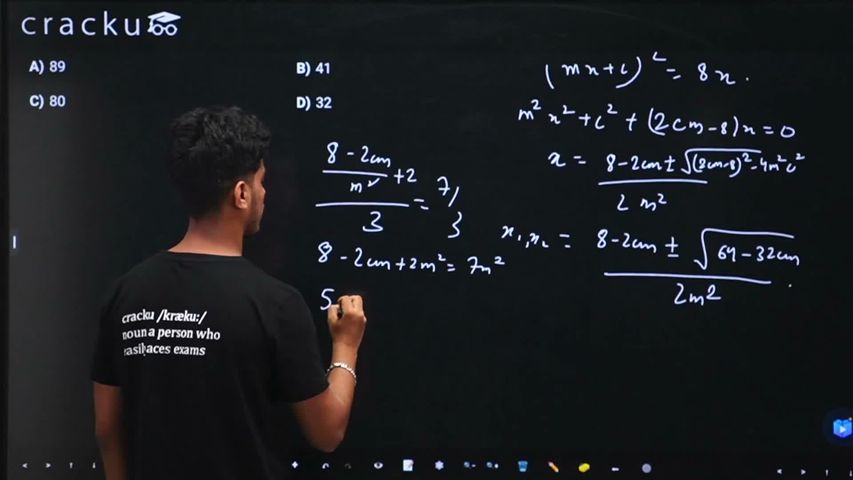
Click on the Email ☝️ to Watch the Video Solution
Create a FREE account and get:
_1.webp)

Educational materials for JEE preparation

Ask our AI anything

AI can make mistakes. Please verify important information.
AI can make mistakes. Please verify important information.
