
Join Our JEE Preparation Group
Prep with like-minded aspirants; Get access to free daily tests and study material.
Sign in
Please select an account to continue using cracku.in
↓ →
Join Our JEE Preparation Group
Prep with like-minded aspirants; Get access to free daily tests and study material.
According to Bohr atom model, in which of the following transitions will the frequency be maximum?
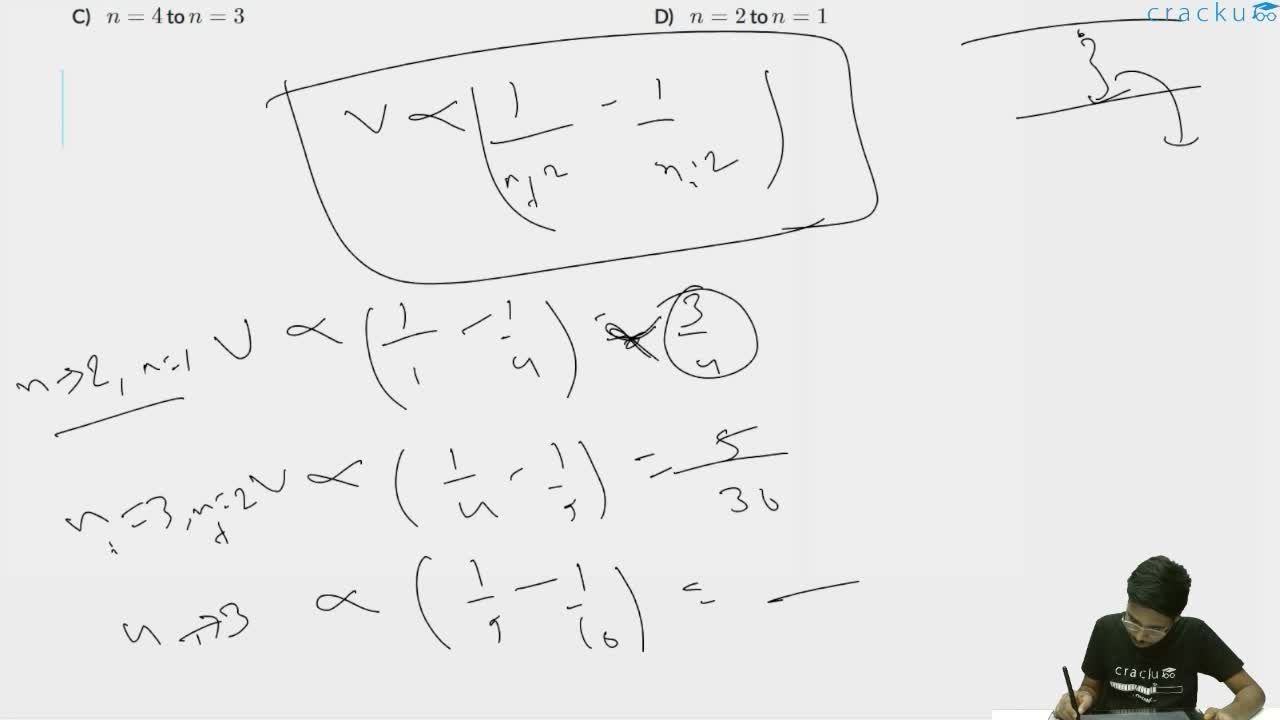
According to the Bohr model, when an electron transitions from a higher energy level $$n_i$$ to a lower energy level $$n_f$$, the frequency of the emitted photon is given by $$\nu = \frac{E_i - E_f}{h} = \frac{13.6 \text{ eV}}{h}\left(\frac{1}{n_f^2} - \frac{1}{n_i^2}\right)$$.
For the transition $$n = 2 \to n = 1$$: $$\nu \propto \left(\frac{1}{1^2} - \frac{1}{2^2}\right) = 1 - \frac{1}{4} = \frac{3}{4} = 0.75$$.
For the transition $$n = 3 \to n = 2$$: $$\nu \propto \left(\frac{1}{4} - \frac{1}{9}\right) = \frac{5}{36} \approx 0.139$$.
For the transition $$n = 4 \to n = 3$$: $$\nu \propto \left(\frac{1}{9} - \frac{1}{16}\right) = \frac{7}{144} \approx 0.049$$.
For the transition $$n = 5 \to n = 4$$: $$\nu \propto \left(\frac{1}{16} - \frac{1}{25}\right) = \frac{9}{400} = 0.0225$$.
Comparing all values, the transition $$n = 2 \to n = 1$$ gives the maximum value of $$\frac{3}{4}$$, and hence the maximum frequency.
The correct answer is the transition from $$n = 2$$ to $$n = 1$$.
Was this solution helpful?
Click on the Email ☝️ to Watch the Video Solution
Create a FREE account and get:
_1.webp)

Educational materials for JEE preparation

Ask our AI anything

AI can make mistakes. Please verify important information.
AI can make mistakes. Please verify important information.


