
Join Our JEE Preparation Group
Prep with like-minded aspirants; Get access to free daily tests and study material.
Sign in
Please select an account to continue using cracku.in
↓ →
Join Our JEE Preparation Group
Prep with like-minded aspirants; Get access to free daily tests and study material.
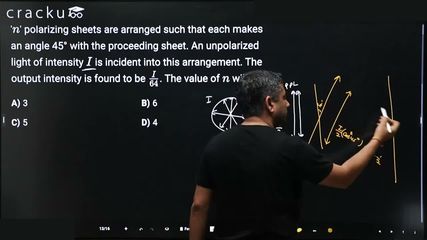
'$$n$$' polarizing sheets are arranged such that each makes an angle 45° with the proceeding sheet. An unpolarized light of intensity $$I$$ is incident into this arrangement. The output intensity is found to be $$\frac{I}{64}$$. The value of $$n$$ will be:
We have $$n$$ polarizing sheets arranged such that each makes an angle of $$45°$$ with the preceding sheet. Unpolarized light of intensity $$I$$ is incident, and the output intensity is $$\frac{I}{64}$$.
When unpolarized light passes through the first polarizer, the intensity becomes:
$$I_1 = \frac{I}{2}$$
Now, by Malus's law, when polarized light passes through a polarizer at angle $$\theta$$, the transmitted intensity is $$I\cos^2\theta$$. Each subsequent sheet is at $$45°$$ to the previous one, so after each sheet the intensity is multiplied by $$\cos^2 45° = \frac{1}{2}$$.
After $$n$$ sheets, the output intensity is:
$$I_{out} = \frac{I}{2} \times \left(\cos^2 45°\right)^{n-1} = \frac{I}{2} \times \left(\frac{1}{2}\right)^{n-1} = \frac{I}{2^n}$$
Setting this equal to $$\frac{I}{64}$$:
$$\frac{I}{2^n} = \frac{I}{64}$$
$$2^n = 64 = 2^6$$
$$n = 6$$
So, the answer is $$6$$.
Was this solution helpful?
Click on the Email ☝️ to Watch the Video Solution
Create a FREE account and get:
_1.webp)

Educational materials for JEE preparation

Ask our AI anything

AI can make mistakes. Please verify important information.
AI can make mistakes. Please verify important information.
