
Join Our JEE Preparation Group
Prep with like-minded aspirants; Get access to free daily tests and study material.
Sign in
Please select an account to continue using cracku.in
↓ →
Join Our JEE Preparation Group
Prep with like-minded aspirants; Get access to free daily tests and study material.
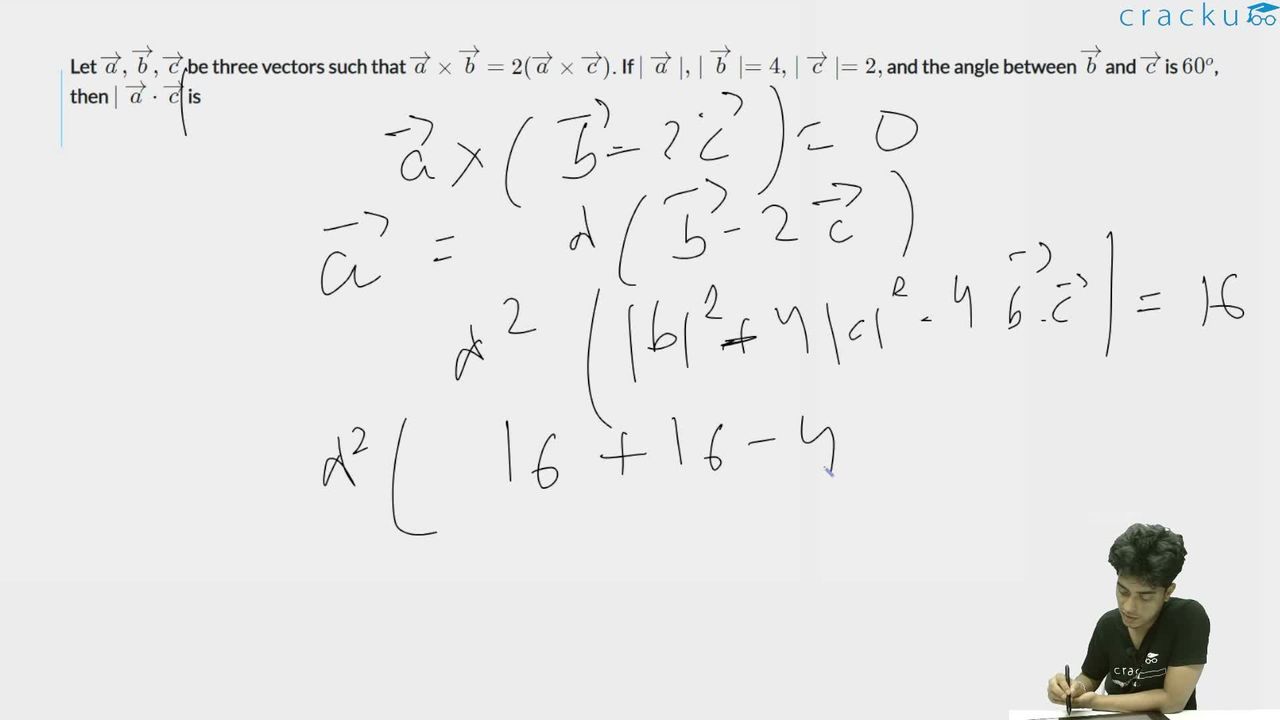
Let $$\overrightarrow{a},\overrightarrow{b},\overrightarrow{c}$$ be three vectors such that $$\overrightarrow{a}\times\overrightarrow{b}=2(\overrightarrow{a}\times\overrightarrow{c}).$$ If $$ \mid \overrightarrow{a}\mid, \mid\overrightarrow{b}\mid = 4, \mid \overrightarrow{c}\mid = 2,$$ and the angle between $$\overrightarrow{b}$$ and $$\overrightarrow{c}$$ is $$60^{o}$$, then $$\mid\overrightarrow{a}\cdot\overrightarrow{c}$$ is
Since $$\overrightarrow{a} \times \overrightarrow{b} = 2(\overrightarrow{a} \times \overrightarrow{c})$$, it follows that $$\overrightarrow{a} \times \overrightarrow{b} - 2(\overrightarrow{a} \times \overrightarrow{c}) = \overrightarrow{0}$$ and hence $$\overrightarrow{a} \times (\overrightarrow{b} - 2\overrightarrow{c}) = \overrightarrow{0}$$. This implies that $$\overrightarrow{a}$$ is parallel to $$(\overrightarrow{b} - 2\overrightarrow{c})$$, so one can write $$(\overrightarrow{b} - 2\overrightarrow{c}) = \lambda\,\overrightarrow{a}$$ for some scalar $$\lambda$$.
Taking magnitudes squared of both sides gives $$|\overrightarrow{b} - 2\overrightarrow{c}|^2 = \lambda^2 |\overrightarrow{a}|^2$$, which expands to $$|\overrightarrow{b}|^2 - 4\,\overrightarrow{b}\cdot\overrightarrow{c} + 4|\overrightarrow{c}|^2 = 16\lambda^2$$. Now $$\overrightarrow{b}\cdot\overrightarrow{c} = |\overrightarrow{b}|\,|\overrightarrow{c}|\cos 60° = 4 \times 2 \times \tfrac12 = 4$$, so this becomes $$16 - 16 + 16 = 16\lambda^2 \implies \lambda^2 = 1 \implies \lambda = \pm 1$$.
Next, taking the dot product with $$\overrightarrow{c}$$ in $$(\overrightarrow{b} - 2\overrightarrow{c}) = \lambda\,\overrightarrow{a}$$ yields $$\overrightarrow{a}\cdot\overrightarrow{c} = \frac{(\overrightarrow{b} - 2\overrightarrow{c})\cdot\overrightarrow{c}}{\lambda} = \frac{\overrightarrow{b}\cdot\overrightarrow{c} - 2|\overrightarrow{c}|^2}{\lambda} = \frac{4 - 8}{\lambda} = \frac{-4}{\lambda}$$. When $$\lambda = 1$$, $$\overrightarrow{a}\cdot\overrightarrow{c} = -4$$ and thus $$|\overrightarrow{a}\cdot\overrightarrow{c}| = 4$$; similarly, when $$\lambda = -1$$, $$\overrightarrow{a}\cdot\overrightarrow{c} = 4$$ so again $$|\overrightarrow{a}\cdot\overrightarrow{c}| = 4$$.
The correct answer is Option A: 4.
Was this solution helpful?
Click on the Email ☝️ to Watch the Video Solution
Create a FREE account and get:
_1.webp)

Educational materials for JEE preparation

Ask our AI anything

AI can make mistakes. Please verify important information.
AI can make mistakes. Please verify important information.
