
Join Our JEE Preparation Group
Prep with like-minded aspirants; Get access to free daily tests and study material.
Sign in
Please select an account to continue using cracku.in
↓ →
Join Our JEE Preparation Group
Prep with like-minded aspirants; Get access to free daily tests and study material.
Let for some function $$y=f(x),\int_{0}^{x}tf(t)dt=x^{2}f(x),x > 0$$ and $$f(2)=3$$. Then $$f(6)$$ is equal to
Given the equation: $$\int_{0}^{x} t f(t) dt = x^{2} f(x), \quad x > 0$$ and $$f(2) = 3$$, we need to find $$f(6)$$.
Differentiate both sides of the equation with respect to $$x$$. The left side, by the Fundamental Theorem of Calculus, gives: $$\frac{d}{dx} \int_{0}^{x} t f(t) dt = x f(x)$$
The right side, using the product rule, gives: $$\frac{d}{dx} \left( x^{2} f(x) \right) = 2x f(x) + x^{2} f'(x)$$
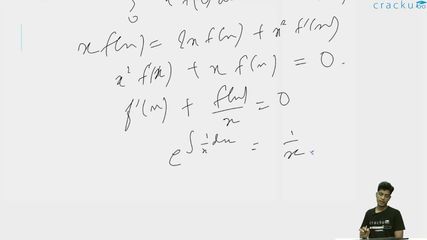
Equating both sides: $$x f(x) = 2x f(x) + x^{2} f'(x)$$
Rearrange the terms: $$x f(x) - 2x f(x) = x^{2} f'(x)$$ $$-x f(x) = x^{2} f'(x)$$
Since $$x > 0$$, divide both sides by $$x$$: $$-f(x) = x f'(x)$$
This simplifies to: $$x f'(x) = -f(x)$$
Separate the variables: $$\frac{f'(x)}{f(x)} = -\frac{1}{x}$$
Integrate both sides: $$\int \frac{f'(x)}{f(x)} dx = \int -\frac{1}{x} dx$$
The left side is $$\ln |f(x)|$$ and the right side is $$-\ln |x| + C$$. Since $$x > 0$$, we can write: $$\ln f(x) = -\ln x + C$$
Simplify: $$\ln f(x) = \ln \left( \frac{1}{x} \right) + C$$
Exponentiate both sides: $$f(x) = e^{\ln (1/x) + C} = e^{\ln (1/x)} \cdot e^{C} = \frac{1}{x} \cdot K$$ where $$K = e^{C}$$ is a constant.
Thus: $$f(x) = \frac{K}{x}$$
Use the given condition $$f(2) = 3$$: $$\frac{K}{2} = 3 \implies K = 6$$
Therefore: $$f(x) = \frac{6}{x}$$
Now find $$f(6)$$: $$f(6) = \frac{6}{6} = 1$$
Verify the solution by substituting into the original equation. Left side: $$\int_{0}^{x} t \cdot \frac{6}{t} dt = \int_{0}^{x} 6 dt = 6t \Big|_{0}^{x} = 6x$$
Right side: $$x^{2} \cdot \frac{6}{x} = 6x$$
Both sides are equal, and $$f(2) = \frac{6}{2} = 3$$, which matches the given condition.
Thus, $$f(6) = 1$$.
The correct option is A. 1.
Was this solution helpful?
Click on the Email ☝️ to Watch the Video Solution
Create a FREE account and get:
_1.webp)

Educational materials for JEE preparation

Ask our AI anything

AI can make mistakes. Please verify important information.
AI can make mistakes. Please verify important information.
