
Join Our JEE Preparation Group
Prep with like-minded aspirants; Get access to free daily tests and study material.
Sign in
Please select an account to continue using cracku.in
↓ →
Join Our JEE Preparation Group
Prep with like-minded aspirants; Get access to free daily tests and study material.
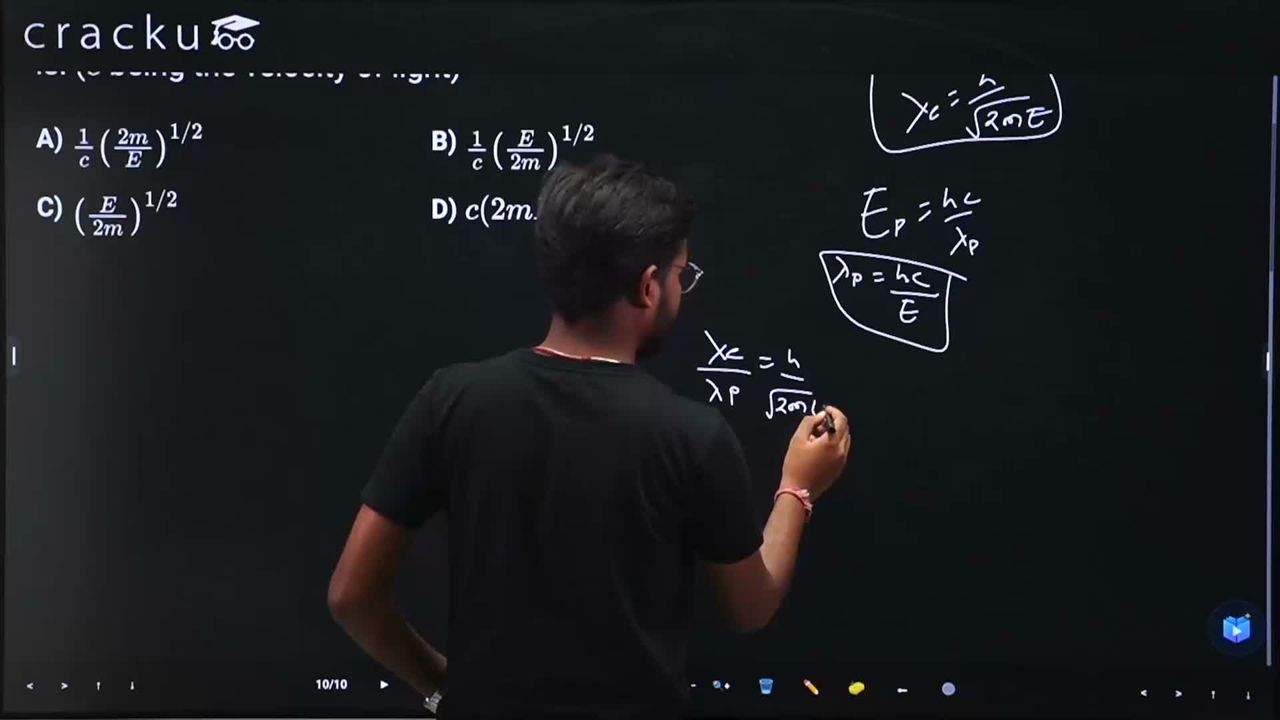
An electron of mass $$m$$ and a photon have same energy $$E$$. The ratio of wavelength of electron to that of photon is: ($$c$$ being the velocity of light)
The de Broglie wavelength of an electron with energy $$E$$ is $$\lambda_e = \frac{h}{p} = \frac{h}{\sqrt{2mE}}$$, since the kinetic energy $$E = \frac{p^2}{2m}$$ gives momentum $$p = \sqrt{2mE}$$.
For a photon with energy $$E$$, we have $$E = \frac{hc}{\lambda_p}$$, so $$\lambda_p = \frac{hc}{E}$$.
The ratio of wavelengths is $$\frac{\lambda_e}{\lambda_p} = \frac{h/\sqrt{2mE}}{hc/E} = \frac{h}{\sqrt{2mE}} \times \frac{E}{hc} = \frac{E}{c\sqrt{2mE}} = \frac{\sqrt{E}}{c\sqrt{2m}} = \frac{1}{c}\sqrt{\frac{E}{2m}}$$.
This can be written as $$\frac{1}{c}\left(\frac{E}{2m}\right)^{1/2}$$, so the correct answer is option 2.
Was this solution helpful?
Click on the Email ☝️ to Watch the Video Solution
Create a FREE account and get:
_1.webp)

Educational materials for JEE preparation

Ask our AI anything

AI can make mistakes. Please verify important information.
AI can make mistakes. Please verify important information.
