
Join Our JEE Preparation Group
Prep with like-minded aspirants; Get access to free daily tests and study material.
Sign in
Please select an account to continue using cracku.in
↓ →
Join Our JEE Preparation Group
Prep with like-minded aspirants; Get access to free daily tests and study material.
Among the statements :
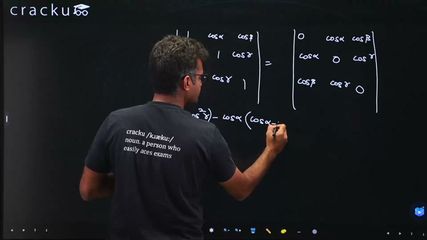
I: If $$ \begin{vmatrix}1 & \cos\alpha & \cos\beta \\\mathbf{\cos\alpha} & 1 & \mathbf{\cos\gamma} \\\mathbf{\cos\beta} & \mathbf{\cos\gamma} & 1\end{vmatrix}=\begin{vmatrix}0 & \mathbf{\cos\alpha}&\mathbf{\cos\beta} \\\mathbf{\cos\alpha} & 0 & \mathbf{\cos\gamma} \\\mathbf{\cos\beta} & \mathbf{\cos\gamma} & 0\end{vmatrix}$$, then $$\cos^{2}\alpha+\cos^{2}\beta+\cos^{2}\gamma=\frac{3}{2}$$, and
II: $$\begin{vmatrix}x^{2}+x & x+1 & x-2 \\2x^{2}+3x-1 & 3x & 3x-3 \\x^{2}+2x+3 & 2x-1 & 2x-1\end{vmatrix} = px + q$$, then $$p^{2}=196q^{2}$$
Statement I
Put $$a=\cos\alpha,\;b=\cos\beta,\;c=\cos\gamma$$.
The first determinant becomes
$$\Delta_1=\begin{vmatrix}1&a&b\\a&1&c\\b&c&1\end{vmatrix}$$
For any symmetric matrix of this type the standard expansion gives
$$\Delta_1=1+2abc-a^{2}-b^{2}-c^{2}\;.\;-(1)$$
The second determinant is
$$\Delta_2=\begin{vmatrix}0&a&b\\a&0&c\\b&c&0\end{vmatrix}$$
Expanding along the first row:
$$\Delta_2=0\cdot\Bigl|\begin{smallmatrix}0&c\\c&0\end{smallmatrix}\Bigr| -a\Bigl|\begin{smallmatrix}a&c\\b&0\end{smallmatrix}\Bigr| +b\Bigl|\begin{smallmatrix}a&0\\b&c\end{smallmatrix}\Bigr| = -a(-bc)+b(ac)=2abc\;.\;-(2)$$
Given $$\Delta_1=\Delta_2$$, substitute $$(1)$$ and $$(2)$$:
$$1+2abc-a^{2}-b^{2}-c^{2}=2abc \;\;\Longrightarrow\;\;1-a^{2}-b^{2}-c^{2}=0$$
Hence $$\cos^{2}\alpha+\cos^{2}\beta+\cos^{2}\gamma=a^{2}+b^{2}+c^{2}=1$$, not $$\frac{3}{2}$$.
So Statement I is false.
Statement II
Let
$$D(x)=\begin{vmatrix}x^{2}+x & x+1 & x-2\\ 2x^{2}+3x-1 & 3x & 3x-3\\ x^{2}+2x+3 & 2x-1 & 2x-1\end{vmatrix}$$
Use the cofactor rule $$D=A_1E_1-B_1E_2+C_1E_3$$ with
$$(A_1,B_1,C_1)=(x^{2}+x,\;x+1,\;x-2).$$
$$E_1=\begin{vmatrix}0&3x-3\\2x-1&0\end{vmatrix}=3(2x-1)=6x-3$$
$$\;\;\Longrightarrow\;A_1E_1=(x^{2}+x)(6x-3)=6x^{3}+3x^{2}-3x$$
$$E_2=\begin{vmatrix}2x^{2}+3x-1&3x-3\\x^{2}+2x+3&2x-1\end{vmatrix}
=x^{3}+x^{2}-8x+10$$
$$\;\;\Longrightarrow\;B_1E_2=(x+1)(x^{3}+x^{2}-8x+10)
=x^{4}+2x^{3}-7x^{2}+2x+10$$
$$E_3=\begin{vmatrix}2x^{2}+3x-1&3x\\x^{2}+2x+3&2x-1\end{vmatrix}
=x^{3}-2x^{2}-14x+1$$
$$\;\;\Longrightarrow\;C_1E_3=(x-2)(x^{3}-2x^{2}-14x+1)
=x^{4}-4x^{3}-10x^{2}+29x-2$$
Therefore
$$D(x)=\bigl(6x^{3}+3x^{2}-3x\bigr) -\bigl(x^{4}+2x^{3}-7x^{2}+2x+10\bigr) +\bigl(x^{4}-4x^{3}-10x^{2}+29x-2\bigr)$$
Simplifying term by term:
$$D(x)=24x-12=12(2x-1)$$
Thus $$p=24,\;q=-12$$ and
$$p^{2}=24^{2}=576,\quad 196q^{2}=196\cdot144=28224\neq576.$$
Hence Statement II is also false.
Both statements are false → Option B.
Was this solution helpful?
Click on the Email ☝️ to Watch the Video Solution
Create a FREE account and get:
_1.webp)

Educational materials for JEE preparation

Ask our AI anything

AI can make mistakes. Please verify important information.
AI can make mistakes. Please verify important information.
