
Join Our JEE Preparation Group
Prep with like-minded aspirants; Get access to free daily tests and study material.
Sign in
Please select an account to continue using cracku.in
↓ →
Join Our JEE Preparation Group
Prep with like-minded aspirants; Get access to free daily tests and study material.
Two ions having same mass have charges in the ratio 1 : 2. They are projected normally in a uniform magnetic field with their speeds in the ratio 2 : 3. The ratio of the radii of their circular trajectories is,
For a charged particle that enters a uniform magnetic field $$\vec B$$ normally (that is, with its velocity perpendicular to the field), the magnetic force supplies the centripetal force required for uniform circular motion. First we write the force equation:
Magnetic force: $$F_{\text{mag}} = q\,v\,B$$
Centripetal force: $$F_{\text{cent}} = \dfrac{m v^{2}}{r}$$
Equating the two forces because the magnetic force itself acts as the centripetal force, we have
$$q\,v\,B = \dfrac{m v^{2}}{r}$$
Now we solve this equation for the radius $$r$$ of the circular path:
$$q\,v\,B = \dfrac{m v^{2}}{r} \;\;\Longrightarrow\;\; q\,v\,B\,r = m v^{2} \;\;\Longrightarrow\;\; r = \dfrac{m v}{q B}$$
So the radius is given by the formula $$r = \dfrac{m v}{q B}.$$
The problem involves two ions. We denote their physical quantities with subscripts 1 and 2:
Same mass: $$m_{1} = m_{2} = m$$
Charge ratio: $$q_{1} : q_{2} = 1 : 2 \;\;\Longrightarrow\;\; q_{1} = q,\; q_{2} = 2q$$
Speed ratio: $$v_{1} : v_{2} = 2 : 3 \;\;\Longrightarrow\;\; v_{1} = 2v,\; v_{2} = 3v$$
Both ions move in the same magnetic field $$B$$, so $$B$$ is common.
Using the formula for each radius, we write
$$r_{1} = \dfrac{m v_{1}}{q_{1} B} = \dfrac{m (2v)}{q B} = \dfrac{2 m v}{q B}$$
$$r_{2} = \dfrac{m v_{2}}{q_{2} B} = \dfrac{m (3v)}{2q B} = \dfrac{3 m v}{2 q B}$$
To find the required ratio of the radii, we divide $$r_{1}$$ by $$r_{2}$$:
$$\dfrac{r_{1}}{r_{2}} = \dfrac{\dfrac{2 m v}{q B}}{\dfrac{3 m v}{2 q B}}$$
Because $$m$$, $$v$$, $$q$$, and $$B$$ are common factors, we can cancel them step by step:
$$\dfrac{r_{1}}{r_{2}} = \dfrac{2}{1}\;\cdot\;\dfrac{1}{1}\;\cdot\;\dfrac{1}{1}\;\cdot\;\dfrac{2}{3} = \dfrac{4}{3}$$
Hence, $$r_{1} : r_{2} = 4 : 3.$$
Checking the options, $$4 : 3$$ corresponds to Option B.
Hence, the correct answer is Option B.
Was this solution helpful?
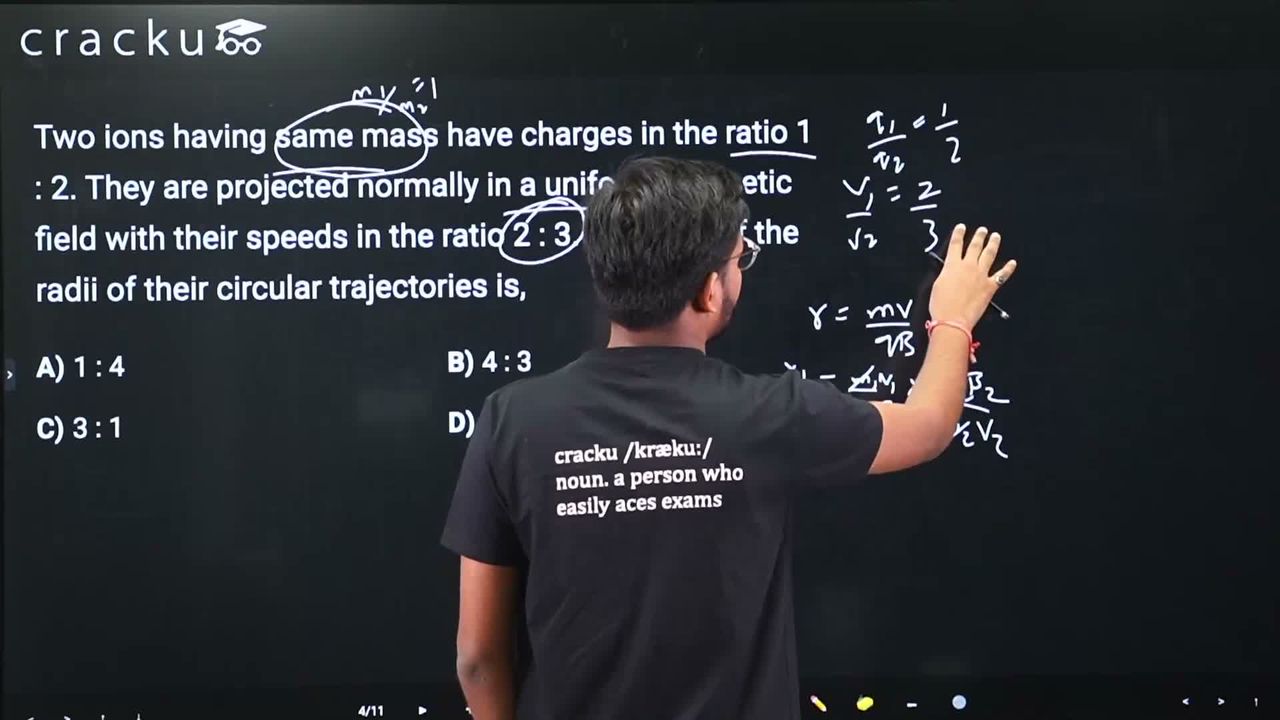
Click on the Email ☝️ to Watch the Video Solution
Create a FREE account and get:
_1.webp)

Educational materials for JEE preparation

Ask our AI anything

AI can make mistakes. Please verify important information.
AI can make mistakes. Please verify important information.
