
Join Our JEE Preparation Group
Prep with like-minded aspirants; Get access to free daily tests and study material.
Sign in
Please select an account to continue using cracku.in
↓ →
Join Our JEE Preparation Group
Prep with like-minded aspirants; Get access to free daily tests and study material.
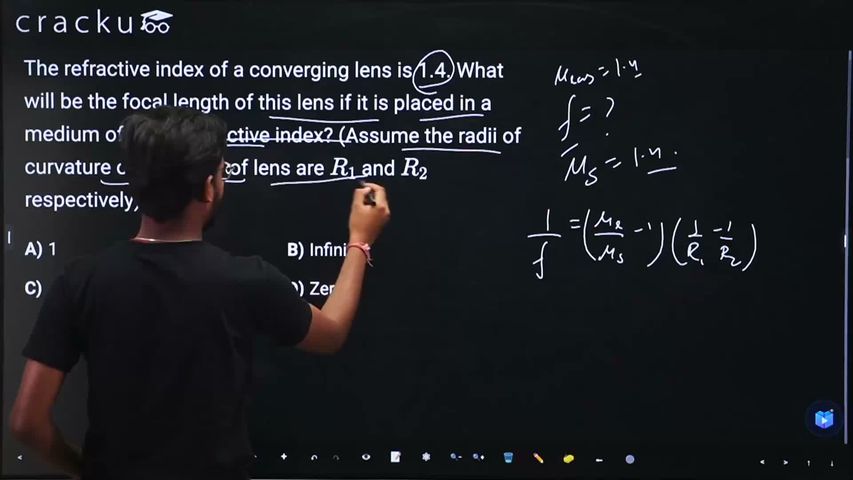
The refractive index of a converging lens is 1.4. What will be the focal length of this lens if it is placed in a medium of same refractive index? (Assume the radii of curvature of the faces of lens are $$R_1$$ and $$R_2$$ respectively)
The focal length of a lens in a medium is given by the lensmaker's equation: $$\frac{1}{f} = \left(\frac{n_{\text{lens}}}{n_{\text{medium}}} - 1\right)\left(\frac{1}{R_1} - \frac{1}{R_2}\right)$$.
When the lens with refractive index $$n_{\text{lens}} = 1.4$$ is placed in a medium of the same refractive index $$n_{\text{medium}} = 1.4$$, the factor becomes $$\frac{n_{\text{lens}}}{n_{\text{medium}}} - 1 = \frac{1.4}{1.4} - 1 = 1 - 1 = 0$$.
Therefore, $$\frac{1}{f} = 0 \times \left(\frac{1}{R_1} - \frac{1}{R_2}\right) = 0$$, which means $$f = \infty$$.
When a lens is immersed in a medium having the same refractive index as the lens material, it loses its converging or diverging ability and behaves like a flat piece of glass. The focal length becomes infinite.
Was this solution helpful?
Click on the Email ☝️ to Watch the Video Solution
Create a FREE account and get:
_1.webp)

Educational materials for JEE preparation

Ask our AI anything

AI can make mistakes. Please verify important information.
AI can make mistakes. Please verify important information.
