
Join Our JEE Preparation Group
Prep with like-minded aspirants; Get access to free daily tests and study material.
Sign in
Please select an account to continue using cracku.in
↓ →
Join Our JEE Preparation Group
Prep with like-minded aspirants; Get access to free daily tests and study material.
To measure the temperature coefficient of resistivity $$\alpha$$ of a semiconductor, an electrical arrangement shown in the figure is prepared. The arm BC is made up of the semiconductor. The experiment is being conducted at 25°C and resistance of the semiconductor arm is $$3 \text{ m}\Omega$$. Arm BC is cooled at a constant rate of $$2 \text{ °C s}^{-1}$$. If the galvanometer G shows no deflection after 10 s, then $$\alpha$$ is
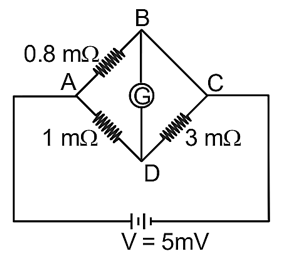
Treat it as a Wheatstone bridge. At balance:
$$\frac{AB}{BC}=\frac{AD}{DC}$$
Given:
AB = 0.8 mΩ
AD = 1 mΩ
DC = 3 mΩ
So,
$$\frac{0.8}{R_{BC}}=\frac{1}{3}\Rightarrow R_{BC}=2.4\text{ mΩ}$$Initially (at 25°C), BC = 3 mΩ
After cooling, it becomes 2.4 mΩ
step 2: temperature change
Cooling rate = 2 °C/s
Time = 10 s
$$\Delta T=20^{\circ}C$$
Final temperature = 25 − 20 = 5°C
step 3: use resistance-temperature relation
$$R=R_0(1+\alpha\Delta T)$$
Here ΔT = −20°C:
$$2.4=3(1+\alpha(-20))$$
$$2.4=3(1-20\alpha)$$
$$0.8=1-20\alpha$$
Was this solution helpful?
Create a FREE account and get:
_1.webp)

Educational materials for JEE preparation

Ask our AI anything

AI can make mistakes. Please verify important information.
AI can make mistakes. Please verify important information.
