
Join Our JEE Preparation Group
Prep with like-minded aspirants; Get access to free daily tests and study material.
Sign in
Please select an account to continue using cracku.in
↓ →
Join Our JEE Preparation Group
Prep with like-minded aspirants; Get access to free daily tests and study material.
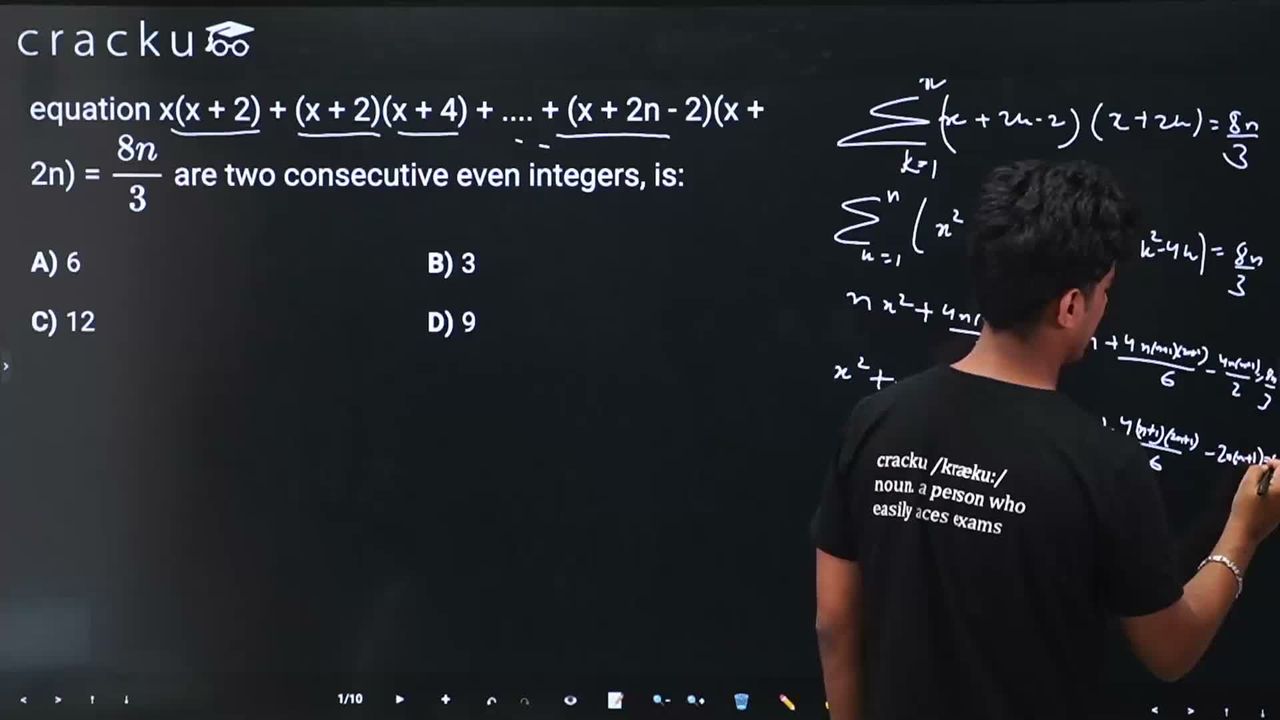
The positive integer n, for which the solutions of the equation x(x + 2) + (x + 2)(x + 4) + .... + (x + 2n - 2)(x + 2n) = $$\dfrac{8n}{3}$$ are two consecutive even integers, is:
$$\sum_{k=0}^{n-1}(x+2k)(x+2k+2)=\frac{8n}{3}\qquad -(1)$$
Expand one general term first:
$$(x+2k)(x+2k+2)=A(A+2)\,,\;A=x+2k$$
$$\;=A^{2}+2A=(x+2k)^{2}+2(x+2k)$$
$$\;=x^{2}+(4k+2)x+4k^{2}+4k\qquad -(2)$$
Add the coefficients separately.
Coefficient of $$x^{2}$$: $$\sum_{k=0}^{n-1}1=n$$
Coefficient of $$x$$: $$\sum_{k=0}^{n-1}(4k+2)=4\sum_{k=0}^{n-1}k+2n=4\frac{(n-1)n}{2}+2n=2n^{2}$$
Constant term: $$\sum_{k=0}^{n-1}\bigl(4k^{2}+4k\bigr)=4\sum k^{2}+4\sum k$$ $$=\frac{4n(n^{2}-1)}{3}\qquad -(3)$$
Substituting these three sums into $$(1)$$ we get
$$n x^{2}+2n^{2}x+\frac{4n(n^{2}-1)}{3}=\frac{8n}{3}$$
$$\Longrightarrow\quad 3x^{2}+6n\,x+4(n^{2}-3)=0\qquad -(4)$$
The quadratic $$(4)$$ has its two roots as consecutive even integers.let them be $$m$$ and $$m+2$$.
Sum of roots $$= -\frac{6n}{3}=-2n$$
$$m+(m+2)=2m+2=-2n\quad\Longrightarrow\quad m=-n-1\qquad -(5)$$
Product of roots $$=\frac{4(n^{2}-3)}{3}$$
$$(m)(m+2)=(-n-1)(-n+1)=n^{2}-1\qquad -(6)$$:
$$n^{2}-1=\frac{4(n^{2}-3)}{3}$$
$$\;n^{2}-9=0$$
$$\;n^{2}=9\quad\Longrightarrow\quad n=3\;(\text{since }n\text{ is positive})$$
The positive integer $$n$$ that satisfies the given condition is $$\mathbf{3}$$.
Was this solution helpful?
Click on the Email ☝️ to Watch the Video Solution
Create a FREE account and get:
_1.webp)

Educational materials for JEE preparation

Ask our AI anything

AI can make mistakes. Please verify important information.
AI can make mistakes. Please verify important information.
