
Join Our JEE Preparation Group
Prep with like-minded aspirants; Get access to free daily tests and study material.
Sign in
Please select an account to continue using cracku.in
↓ →
Join Our JEE Preparation Group
Prep with like-minded aspirants; Get access to free daily tests and study material.
Let $$T_{r}$$ be the $$r^{th}$$ term of an A.P. If for some m,$$T_{m}=\frac{1}{25},T_{25}=\frac{1}{20}$$, and $$20\sum_{r=1}^{25}T_{r}=13$$,then $$5m\sum_{r=m}^{2m}T_{r}$$ is equal to
Here is the step-by-step solution to the problem:
Step 1: Find the first term ($$a$$) and common difference ($$d$$) of the A.P.
We are given two conditions for the $$m$$-th and $$25$$-th terms of the A.P.:
Subtract the second equation from the first to eliminate $a$:
$$(m - 1)d - 24d = \frac{1}{25} - \frac{1}{m},$$ $$(m - 25)d = \frac{m - 25}{25m}$$
Assuming $$m \neq 25$$, we can divide both sides by $$(m - 25)$$:
$$d = \frac{1}{25m}$$
Now, substitute $$d$$ back into the second equation to find $$a$$:
$$a + 24\left(\frac{1}{25m}\right) = \frac{1}{m},$$ $$a = \frac{1}{m} - \frac{24}{25m} = \frac{25 - 24}{25m} = \frac{1}{25m}$$
So, both the first term and the common difference are equal: $$a = d = \frac{1}{25m}$$.
This means the $$r$$-th term is:
$$T_r = a + (r - 1)d = \frac{1}{25m} + \frac{r - 1}{25m} = \frac{r}{25m}$$
Step 2: Use the sum condition to find the value of $$m$$
We are given the condition:
$$20 \sum_{r=1}^{25} T_r = 13$$
Let's first evaluate the sum $$\sum_{r=1}^{25} T_r$$:
$$\sum_{r=1}^{25} \frac{r}{25m} = \frac{1}{25m} \sum_{r=1}^{25} r$$
Using the sum of the first $$n$$ natural numbers formula ($$\frac{n(n+1)}{2}$$):
$$\sum_{r=1}^{25} T_r = \frac{1}{25m} \times \frac{25 \times 26}{2} = \frac{13}{m}$$
Now substitute this back into the given condition:
$$20 \left( \frac{13}{m} \right) = 13$$ $$m = 20$$
Step 3: Evaluate the final expression
Now that we know $$m = 20$$, our general term is:
$$T_r = \frac{r}{25(20)} = \frac{r}{500}$$
We need to find the value of:
$$5m \sum_{r=m}^{2m} T_r$$
Substitute $$m = 20$$:
$$= 5(20) \sum_{r=20}^{40} T_r$$ $$= 100 \sum_{r=20}^{40} \frac{r}{500}$$ $$= \frac{100}{500} \sum_{r=20}^{40} r$$ $$= \frac{1}{5} \sum_{r=20}^{40} r$$
To find the sum of integers from 20 to 40, we can use the arithmetic series sum formula $$S = \frac{n}{2}(\text{first term} + \text{last term})$$.
The number of terms $$n$$ is $$40 - 20 + 1 = 21$$.
$$\text{Sum} = \frac{21}{2} (20 + 40) = \frac{21}{2} (60) = 21 \times 30 = 630$$
Finally, multiply this sum by $$\frac{1}{5}$$:
$$= \frac{1}{5} \times 630 = 126$$
Final Answer:
The value of the expression is 126.
Was this solution helpful?
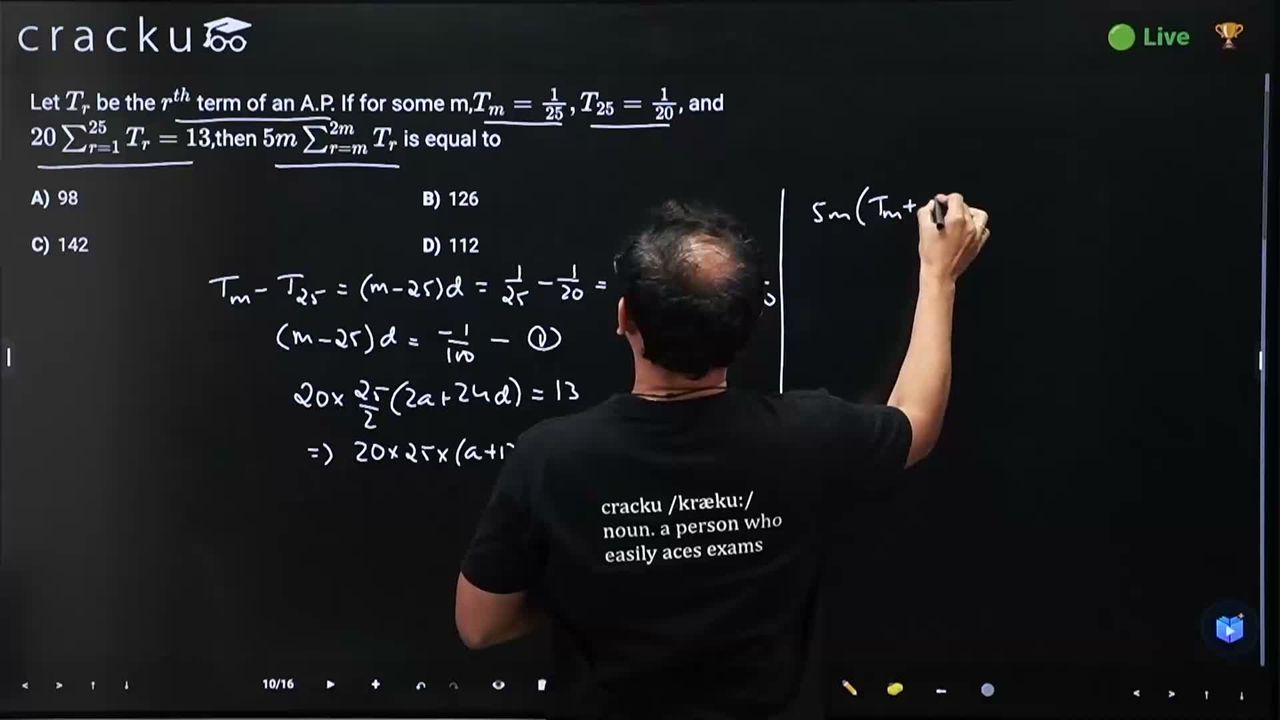
Click on the Email ☝️ to Watch the Video Solution
Create a FREE account and get:
_1.webp)

Educational materials for JEE preparation

Ask our AI anything

AI can make mistakes. Please verify important information.
AI can make mistakes. Please verify important information.
