
Join Our JEE Preparation Group
Prep with like-minded aspirants; Get access to free daily tests and study material.
Sign in
Please select an account to continue using cracku.in
↓ →
Join Our JEE Preparation Group
Prep with like-minded aspirants; Get access to free daily tests and study material.
If $$\alpha$$ and $$\beta$$ ($$\alpha < \beta$$) are the roots of the equation $$(-2+\sqrt{3})(|\sqrt{x}-3|)+(x-6\sqrt{x})+(9-2\sqrt{3})=0,x\geq0\text{ then }\sqrt{\frac{\beta}{\alpha}}+\sqrt{\alpha\beta}$$ is equal to:
To solve this equation, let's look for a way to simplify it using substitution.
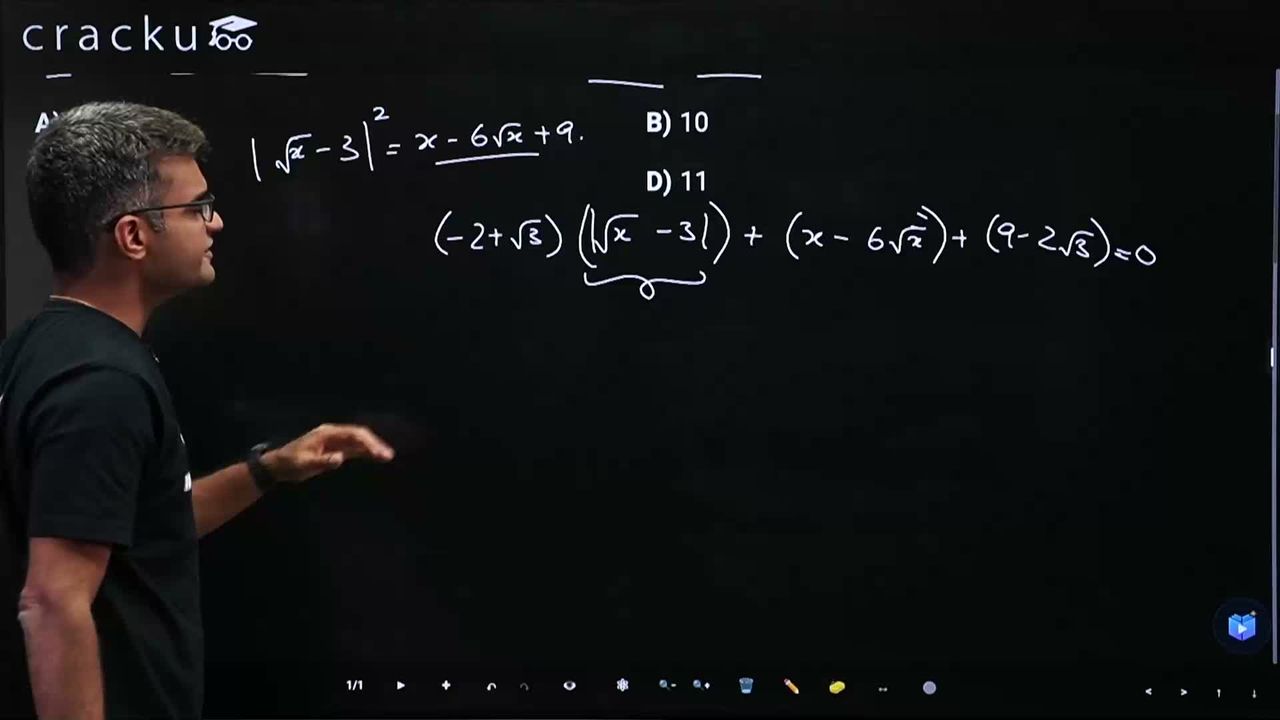
Notice that the terms $$(x - 6\sqrt{x})$$ and the $$9$$ from the last constant term can be grouped to form a perfect square:
$$x - 6\sqrt{x} + 9 = (\sqrt{x} - 3)^2 = |\sqrt{x} - 3|^2$$
Substitute this back into the original equation to reorganize it:
$$(-2 + \sqrt{3})|\sqrt{x} - 3| + |\sqrt{x} - 3|^2 - 2\sqrt{3} = 0$$
Let $$t = |\sqrt{x} - 3|$$. Since $$t$$ represents an absolute value, we know that $$t \ge 0$$.
The equation now becomes a standard quadratic in terms of $$t$$:
$$t^2 + (-2 + \sqrt{3})t - 2\sqrt{3} = 0$$
We can factor this quadratic by splitting the middle term:
$$t^2 - 2t + \sqrt{3}t - 2\sqrt{3} = 0$$
$$t(t - 2) + \sqrt{3}(t - 2) = 0$$
$$(t - 2)(t + \sqrt{3}) = 0$$
This gives two possible values for $$t$$:
$$t = 2$$ or $$t = -\sqrt{3}$$
Since we established that $$t \ge 0$$, we reject $$-\sqrt{3}$$. Therefore, $$t = 2$$.
Substitute back $$t = |\sqrt{x} - 3|$$:
$$|\sqrt{x} - 3| = 2$$
This results in two distinct cases:
The roots of the equation are $$1$$ and $$25$$. We are given that $$\alpha$$ and $$\beta$$ are the roots with $$\alpha < \beta$$, which means:
Finally, substitute these values into the expression we need to evaluate:
$$\sqrt{\frac{\beta}{\alpha}} + \sqrt{\alpha\beta}$$
$$= \sqrt{\frac{25}{1}} + \sqrt{(1)(25)}$$
$$= 5 + 5 = 10$$
Was this solution helpful?
Click on the Email ☝️ to Watch the Video Solution
Create a FREE account and get:
_1.webp)

Educational materials for JEE preparation

Ask our AI anything

AI can make mistakes. Please verify important information.
AI can make mistakes. Please verify important information.
