
Join Our JEE Preparation Group
Prep with like-minded aspirants; Get access to free daily tests and study material.
Sign in
Please select an account to continue using cracku.in
↓ →
Join Our JEE Preparation Group
Prep with like-minded aspirants; Get access to free daily tests and study material.
A very long wire ABDMNDC is shown in figure carrying current I. AB and BC parts are straight, long and at right angle. At D wire forms a circular turn DMND of radius R. AB, BC parts are tangential to circular turn at N and D. Magnetic field at the center of circle is:
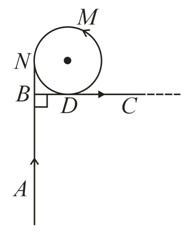
Let the centre of the circular portion be O and its radius be $$R$$. We have to add the magnetic fields produced at O by
(i) the complete circular turn $$DMND$$ and
(ii) the two very long straight parts $$AB$$ and $$BC$$ which touch the circle tangentially at the points $$N$$ and $$D$$ respectively.
Field due to the circular turn
For a circular loop carrying current $$I$$, the magnetic field at its centre is given by the well-known result
$$B_{\text{circle}}=\frac{\mu_0 I}{2R}\;.$$
It will be directed perpendicular to the plane of the loop. Writing the same expression with a denominator $$2\pi R$$ (so that all later terms have a common factor) we have
$$B_{\text{circle}}=\frac{\mu_0 I}{2\pi R}\,\pi\;.$$
Field due to the straight part AB
For a finite straight conductor the Biot-Savart result is
$$B=\frac{\mu_0 I}{4\pi r}\,(\sin\theta_1+\sin\theta_2),$$
where $$r$$ is the perpendicular distance of the point from the wire and $$\theta_1,\;\theta_2$$ are the angles which the lines joining the point to the two ends of the conductor make with the conductor itself.
The perpendicular distance of O from AB is clearly $$R$$ (AB is a tangent). One end of AB (the point A) is at infinity, so the line AO is almost along AB itself; hence $$\theta_A=0^\circ$$ and $$\sin\theta_A=0$$. The other end is B. Because B has the coordinates $$(R,\;R)$$ while the wire AB is horizontal, the line OB makes an angle of $$45^\circ$$ with AB, giving $$\theta_B=45^\circ$$ and $$\sin\theta_B=\dfrac1{\sqrt2}$$. Substituting,
$$B_{AB}=\frac{\mu_0 I}{4\pi R}\left(0+\frac1{\sqrt2}\right)=\frac{\mu_0 I}{4\pi R\sqrt2}\;.$$
Field due to the straight part BC
Exactly the same geometry holds for BC, because BC is a vertical tangent lying a distance $$R$$ from O. Again one end (C) is at infinity giving $$\sin\theta_C=0$$, while the nearer end B subtends $$45^\circ$$ with BC giving $$\sin\theta_B=\dfrac1{\sqrt2}$$. Therefore
$$B_{BC}=\frac{\mu_0 I}{4\pi R}\left(\frac1{\sqrt2}+0\right)=\frac{\mu_0 I}{4\pi R\sqrt2}\;.$$
Directions of the straight-wire fields
If the current reaches the junction B from A (i.e.\ it flows to the left along AB) and then turns to flow upward along BC, the right-hand rule shows that both $$B_{AB}$$ and $$B_{BC}$$ point out of the plane of the paper. Hence the two contributions add:
$$B_{\text{straight}}=B_{AB}+B_{BC}=\frac{\mu_0 I}{4\pi R\sqrt2}+\frac{\mu_0 I}{4\pi R\sqrt2} =\frac{\mu_0 I}{2\pi R\sqrt2}\;.$$
Total field at the centre
Adding the circular and straight-wire fields (both are perpendicular to the plane and hence add algebraically)
$$\begin{aligned} B_{\text{net}}&=B_{\text{circle}}+B_{\text{straight}}\\[4pt] &=\frac{\mu_0 I}{2\pi R}\,\pi+\frac{\mu_0 I}{2\pi R}\,\frac1{\sqrt2}\\[4pt] &=\frac{\mu_0 I}{2\pi R}\left(\pi+\frac1{\sqrt2}\right). \end{aligned}$$
Hence, the correct answer is Option A.
Was this solution helpful?
Create a FREE account and get:
_1.webp)

Educational materials for JEE preparation

Ask our AI anything

AI can make mistakes. Please verify important information.
AI can make mistakes. Please verify important information.


