
Join Our JEE Preparation Group
Prep with like-minded aspirants; Get access to free daily tests and study material.
Sign in
Please select an account to continue using cracku.in
↓ →
Join Our JEE Preparation Group
Prep with like-minded aspirants; Get access to free daily tests and study material.
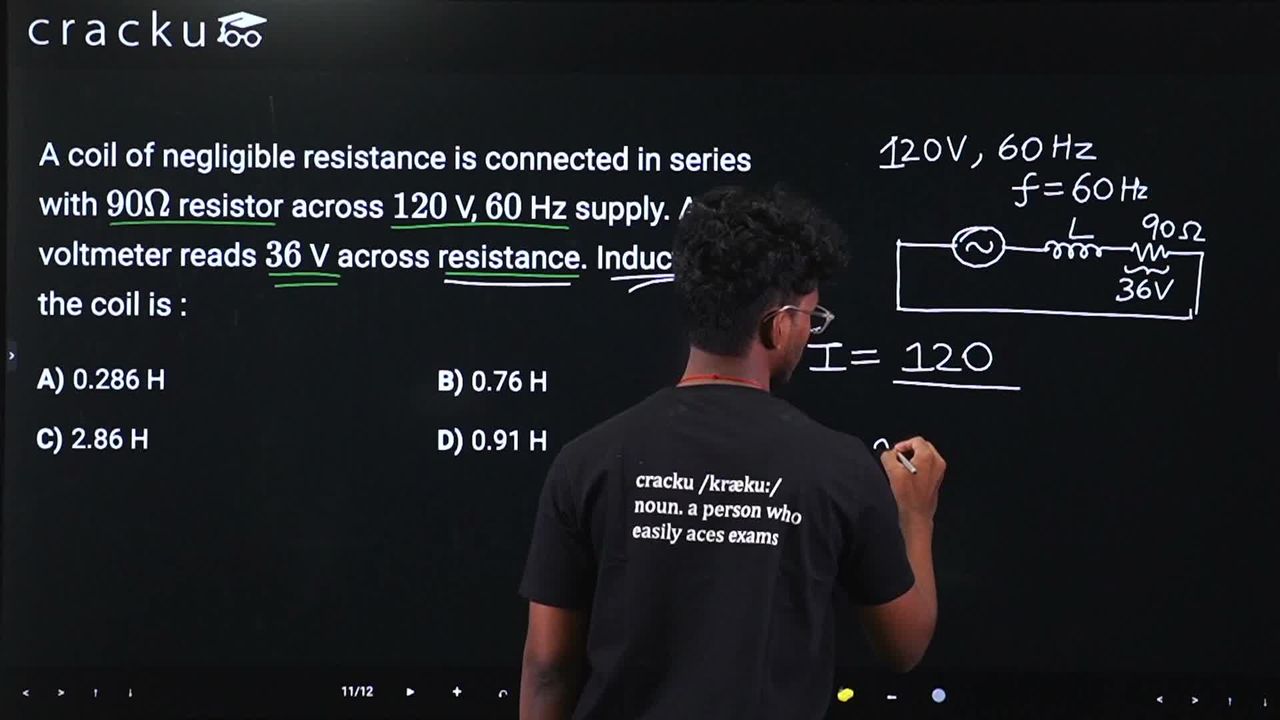
A coil of negligible resistance is connected in series with $$90\Omega$$ resistor across $$120$$ V, $$60$$ Hz supply. A voltmeter reads $$36$$ V across resistance. Inductance of the coil is :
The series circuit consists of a pure resistor $$R = 90\,\Omega$$ and a coil whose resistance is negligible (so it behaves as a pure inductor with inductive reactance $$X_L$$). The applied rms supply is $$V = 120\,\text{V}$$ at frequency $$f = 60\,\text{Hz}$$.
The voltmeter shows the rms voltage across the resistor to be $$V_R = 36\,\text{V}$$. For a pure resistor, voltage and current are in phase, so the rms current in the entire series circuit is
$$I = \frac{V_R}{R} = \frac{36}{90} = 0.40\,\text{A}$$
In an $$R$$-$$L$$ series combination, the resistor voltage $$V_R$$ is in phase with the current while the inductor voltage $$V_L$$ leads the current by $$90^{\circ}$$. Therefore, the supply voltage is the vector (phasor) sum of $$V_R$$ and $$V_L$$, giving the rms relation
$$V = \sqrt{V_R^{2} + V_L^{2}} \quad -(1)$$
Rearranging $$(1)$$ for $$V_L$$:
$$V_L = \sqrt{V^{2} - V_R^{2}} = \sqrt{(120)^{2} - (36)^{2}}$$
$$V_L = \sqrt{14400 - 1296} = \sqrt{13104} \approx 1.145 \times 10^{2}\,\text{V}$$
Thus, $$V_L \approx 114\,\text{V}$$.
The inductive reactance is then obtained from Ohm’s law for the inductor:
$$X_L = \frac{V_L}{I} = \frac{114}{0.40} \approx 285\,\Omega$$
For a pure inductor, $$X_L = 2\pi f L$$. Therefore, the inductance $$L$$ is
$$L = \frac{X_L}{2\pi f} = \frac{285}{2\pi \times 60}$$
$$L = \frac{285}{120\pi} \approx \frac{285}{376.99} \approx 0.756\,\text{H}$$
Rounding to two significant figures, $$L \approx 0.76\,\text{H}$$.
Answer: Option B (0.76 H)
Was this solution helpful?
Click on the Email ☝️ to Watch the Video Solution
Create a FREE account and get:
_1.webp)

Educational materials for JEE preparation

Ask our AI anything

AI can make mistakes. Please verify important information.
AI can make mistakes. Please verify important information.
