
Join Our JEE Preparation Group
Prep with like-minded aspirants; Get access to free daily tests and study material.
Sign in
Please select an account to continue using cracku.in
↓ →
Join Our JEE Preparation Group
Prep with like-minded aspirants; Get access to free daily tests and study material.
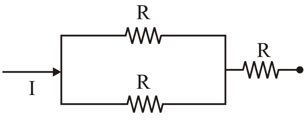
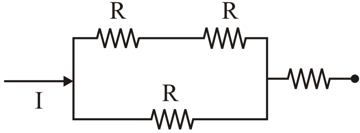
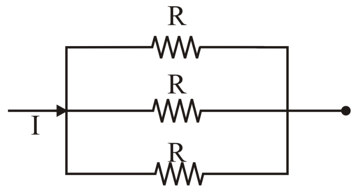
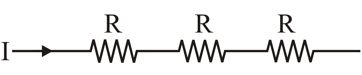
Different combination of 3 resistors of equal resistance $$R$$ are shown in the figures. The increasing order for power dissipation is:
(A)
(B)
(C)
(D)
$$P = I^2 R_{eq}$$
Therefore, the increasing order of power dissipation will be identical to the increasing order of equivalent resistance ($$R_{eq}$$).
Circuit A: $$R_{parallel} = \frac{R}{2}$$
$$R_{eq, A} = \frac{R}{2} + R = \mathbf{1.5R}$$
Circuit B: $$R_{series} = 2R$$
$$R_{eq, B} = \frac{2R \times R}{2R + R} = \frac{2}{3}R \approx \mathbf{0.67R}$$
Circuit C: $$R_{eq, C} = \frac{R}{3} \approx \mathbf{0.33R}$$
Circuit D: $$R_{eq, D} = R + R + R = \mathbf{3R}$$
$$0.33R < 0.67R < 1.5R < 3R$$
$$\implies R_{eq, C} < R_{eq, B} < R_{eq, A} < R_{eq, D}$$
$$\mathbf{P_C < P_B < P_A < P_D}$$
Was this solution helpful?
Create a FREE account and get:
_1.webp)

Educational materials for JEE preparation

Ask our AI anything

AI can make mistakes. Please verify important information.
AI can make mistakes. Please verify important information.


