
Join Our JEE Preparation Group
Prep with like-minded aspirants; Get access to free daily tests and study material.
Sign in
Please select an account to continue using cracku.in
↓ →
Join Our JEE Preparation Group
Prep with like-minded aspirants; Get access to free daily tests and study material.
A wire of length 2L, is made by joining two wires A and B of same length but different radii r and 2r and made of the same material. It is vibrating at a frequency such that the joint of the two wires forms a node. If the number of antinodes in wire A is p and that in B is q then ratio p:q is:
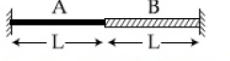
We have a composite stretched wire of total length $$2L$$. It is prepared by joining two separate wires, called A and B, each of length $$L$$. Both wires are made of the same material and hence have the same mass-density (per unit volume) and are under the same tensile force $$T$$ when the whole wire is set up on a sonometer (or any similar frame).
Let the radius of wire A be $$r$$ and that of wire B be $$2r$$. Because cross-sectional area of a wire is $$\pi r^{2}$$, the linear mass density (mass per unit length)
$$\mu=\rho\,\pi r^{2},$$
where $$\rho$$ is the material density (same for both). So
$$\mu_{A}=\rho\pi r^{2},$$
$$\mu_{B}=\rho\pi(2r)^{2}=4\rho\pi r^{2}=4\mu_{A}.$$
The speed of a transverse wave on a stretched wire is given first:
$$v=\sqrt{\dfrac{T}{\mu}}.$$
Substituting the two values of $$\mu$$, we obtain
$$v_{A}= \sqrt{\dfrac{T}{\mu_{A}}},$$
$$v_{B}= \sqrt{\dfrac{T}{\mu_{B}}}= \sqrt{\dfrac{T}{4\mu_{A}}}= \dfrac{1}{2}\sqrt{\dfrac{T}{\mu_{A}}}= \dfrac{v_{A}}{2}.$$
Thus $$v_{B}= \dfrac{v_{A}}{2}.$$
The joint between the two wires acts as a node (displacement is zero there). The outer ends are fixed as well, so each individual piece behaves exactly like an independent string with both ends fixed: one end at the outer support and the other at the junction node.
If a string of length $$L$$ with both ends fixed vibrates in its $$n^{\text{th}}$$ harmonic, its length equals $$n$$ half-wavelengths:
$$L = n\left(\dfrac{\lambda}{2}\right).$$
The number of antinodes (loops) present is the same integer $$n$$. Therefore,
For wire A: $$\displaystyle L = p\left(\dfrac{\lambda_{A}}{2}\right) \;\Longrightarrow\; \lambda_{A}= \dfrac{2L}{p}.$$
For wire B: $$\displaystyle L = q\left(\dfrac{\lambda_{B}}{2}\right) \;\Longrightarrow\; \lambda_{B}= \dfrac{2L}{q}.$$
Because the two portions form a single continuous system, the frequency of vibration is the same in both parts. Using $$f=\dfrac{v}{\lambda}$$, we write
$$f = \dfrac{v_{A}}{\lambda_{A}} = \dfrac{v_{B}}{\lambda_{B}}.$$
Substituting the expressions for $$\lambda_{A}$$ and $$\lambda_{B}$$, we get
$$\dfrac{v_{A}}{\,\dfrac{2L}{p}\,}= \dfrac{v_{B}}{\,\dfrac{2L}{q}\,}.$$
Simplifying the denominators first:
$$\dfrac{p\,v_{A}}{2L}= \dfrac{q\,v_{B}}{2L}.$$
The factors $$2L$$ cancel out, leaving
$$p\,v_{A}= q\,v_{B}.$$
We already have $$v_{B}= \dfrac{v_{A}}{2}$$, so substituting this value:
$$p\,v_{A}= q\left(\dfrac{v_{A}}{2}\right).$$
Dividing both sides by $$v_{A}$$ (non-zero), we obtain
$$p= \dfrac{q}{2}.$$
Re-writing,
$$\dfrac{p}{q}= \dfrac{1}{2} \;\Longrightarrow\; p:q = 1:2.$$
Hence, the correct answer is Option D.
Was this solution helpful?
Create a FREE account and get:
_1.webp)

Educational materials for JEE preparation

Ask our AI anything

AI can make mistakes. Please verify important information.
AI can make mistakes. Please verify important information.
