
Join Our JEE Preparation Group
Prep with like-minded aspirants; Get access to free daily tests and study material.
Sign in
Please select an account to continue using cracku.in
↓ →
Join Our JEE Preparation Group
Prep with like-minded aspirants; Get access to free daily tests and study material.
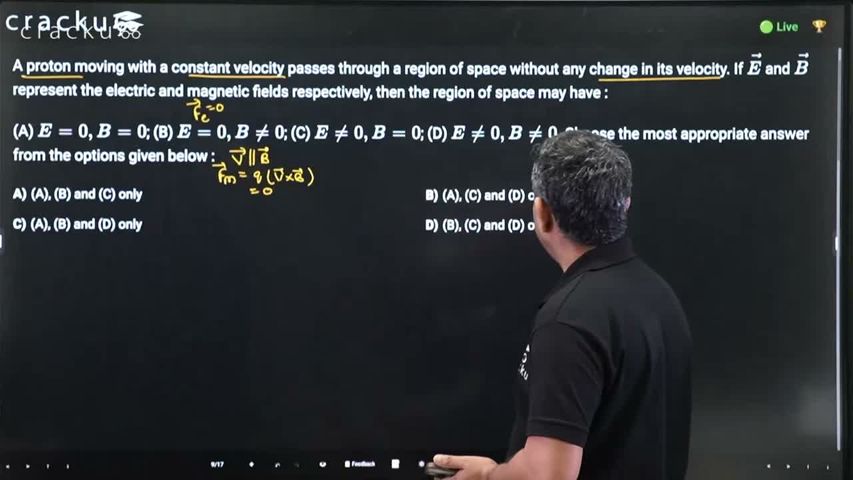
A proton moving with a constant velocity passes through a region of space without any change in its velocity. If $$\vec{E}$$ and $$\vec{B}$$ represent the electric and magnetic fields respectively, then the region of space may have :
(A) $$E = 0, B = 0$$; (B) $$E = 0, B \neq 0$$; (C) $$E \neq 0, B = 0$$; (D) $$E \neq 0, B \neq 0$$. Choose the most appropriate answer from the options given below :
A proton moves with constant velocity, meaning the net force on it is zero.
(A) $$E = 0, B = 0$$: No force, proton moves at constant velocity. Possible.
(B) $$E = 0, B \neq 0$$: If the proton moves parallel to $$\vec{B}$$, the magnetic force $$q\vec{v} \times \vec{B} = 0$$. Possible.
(C) $$E \neq 0, B = 0$$: The electric force $$q\vec{E} \neq 0$$, so the proton would accelerate. Not possible.
(D) $$E \neq 0, B \neq 0$$: If $$q\vec{E} + q\vec{v} \times \vec{B} = 0$$, the electric and magnetic forces can cancel. Possible.
The correct options are (A), (B) and (D) only, which corresponds to Option (3).
Was this solution helpful?
Click on the Email ☝️ to Watch the Video Solution
Create a FREE account and get:
_1.webp)

Educational materials for JEE preparation

Ask our AI anything

AI can make mistakes. Please verify important information.
AI can make mistakes. Please verify important information.
