
Join Our JEE Preparation Group
Prep with like-minded aspirants; Get access to free daily tests and study material.
Sign in
Please select an account to continue using cracku.in
↓ →
Join Our JEE Preparation Group
Prep with like-minded aspirants; Get access to free daily tests and study material.
The area (in sq. units) of the region $$\left\{(x,y): 0\leq y\leq 2|x|+1,0\leq y\leq x^{2}+1,|x|\leq 3\right\}$$ is
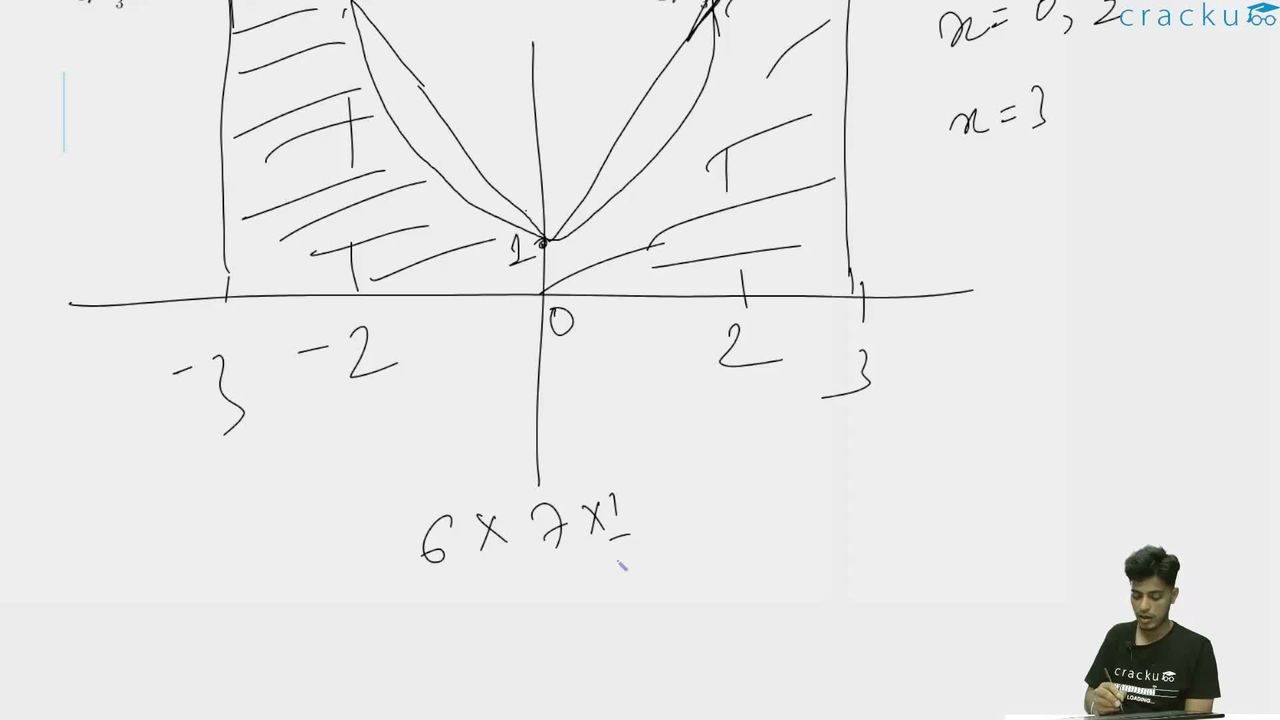
The region is defined by the inequalities $$0 \leq y \leq 2|x| + 1$$, $$0 \leq y \leq x^2 + 1$$, and $$|x| \leq 3$$.
The curves $$y = 2|x| + 1$$ and $$y = x^2 + 1$$ are symmetric about the y-axis. Therefore, the area can be computed for $$x \geq 0$$ and doubled to account for the symmetry.
For $$x \geq 0$$, the inequalities simplify to $$0 \leq y \leq \min\{2x + 1, x^2 + 1\}$$ and $$0 \leq x \leq 3$$. The curves intersect when $$x^2 + 1 = 2x + 1$$, which simplifies to $$x^2 - 2x = 0$$, or $$x(x - 2) = 0$$. The solutions are $$x = 0$$ and $$x = 2$$.
To determine which curve is below the other: - For $$0 \leq x \leq 2$$, $$x^2 + 1 \leq 2x + 1$$, so the minimum is $$x^2 + 1$$. - For $$2 \leq x \leq 3$$, $$2x + 1 \leq x^2 + 1$$, so the minimum is $$2x + 1$$. The area for $$x \geq 0$$ is split into two integrals: 1. From $$x = 0$$ to $$x = 2$$: $$\int_{0}^{2} (x^2 + 1) dx$$ 2. From $$x = 2$$ to $$x = 3$$: $$\int_{2}^{3} (2x + 1) dx$$
Compute the first integral:
The antiderivative of $$x^2 + 1$$ is $$\frac{x^3}{3} + x$$.
Evaluating from 0 to 2:
$$\left[ \frac{(2)^3}{3} + 2 \right] - \left[ \frac{(0)^3}{3} + 0 \right] = \left[ \frac{8}{3} + 2 \right] - 0 = \frac{8}{3} + \frac{6}{3} = \frac{14}{3}$$
Compute the second integral:
The antiderivative of $$2x + 1$$ is $$x^2 + x$$.
Evaluating from 2 to 3:
$$\left[ (3)^2 + 3 \right] - \left[ (2)^2 + 2 \right] = [9 + 3] - [4 + 2] = 12 - 6 = 6$$
Area for $$x \geq 0$$ is $$\frac{14}{3} + 6 = \frac{14}{3} + \frac{18}{3} = \frac{32}{3}$$.
Double this area for the symmetric region ($$x \leq 0$$):
Total area = $$2 \times \frac{32}{3} = \frac{64}{3}$$.
Thus, the area of the region is $$\frac{64}{3}$$, which corresponds to option B.
$$\dfrac{64}{3}$$
Was this solution helpful?
Click on the Email ☝️ to Watch the Video Solution
Create a FREE account and get:
_1.webp)

Educational materials for JEE preparation

Ask our AI anything

AI can make mistakes. Please verify important information.
AI can make mistakes. Please verify important information.
