
Join Our JEE Preparation Group
Prep with like-minded aspirants; Get access to free daily tests and study material.
Sign in
Please select an account to continue using cracku.in
↓ →
Join Our JEE Preparation Group
Prep with like-minded aspirants; Get access to free daily tests and study material.
Let $$f: \mathbb{R} \rightarrow \mathbb{R}$$ be a twice differentiable function such that $$f(x+y)=f(x)f(y)$$ for all $$x,y \in R.$$ If $$f^{'}(0)=4a$$ and $$f$$ satisfies $$f^{''}(x)-3af^{'}(x)-f(x)=0,a>0$$, then the area of the region $$R= \left\{(x,y) \mid 0\leq y\leq f(ax), 0\leq x \leq2 \right\}$$ is
Setting $$x = 0$$ and $$y = 0$$ in the functional equation:
$$f(0 + 0) = f(0) \cdot f(0)$$
$$f(0) = [f(0)]^{2}$$
This gives $$f(0)(f(0) - 1) = 0$$, so $$f(0) = 0$$ or $$f(0) = 1$$.
If $$f(0) = 0$$, then for any $$x$$: $$f(x) = f(x + 0) = f(x) \cdot f(0) = 0$$, making $$f$$ identically zero. But we are given $$f'(0) = 4a$$ with $$a \gt 0$$, so $$f$$ is not identically zero. Therefore, $$f(0) = 1$$.
Differentiating $$f(x + y) = f(x)f(y)$$ with respect to $$x$$ (treating $$y$$ as a constant):
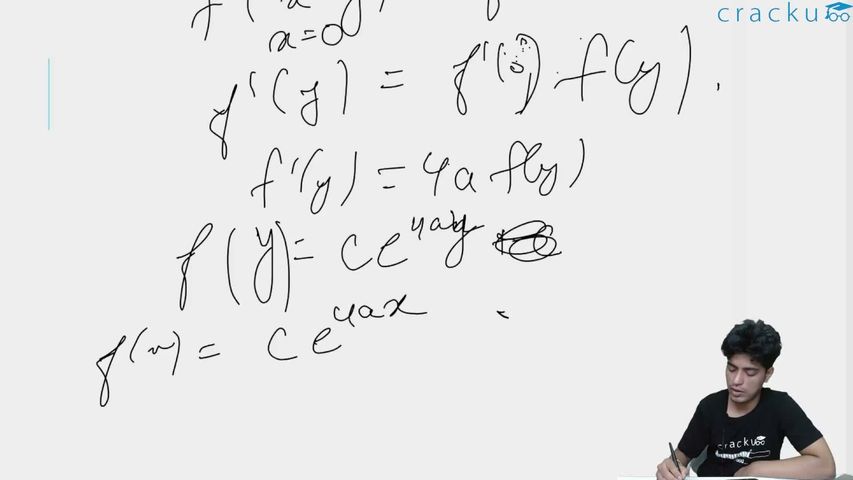
$$f'(x + y) = f'(x) \cdot f(y)$$
Setting $$x = 0$$:
$$f'(y) = f'(0) \cdot f(y) = 4a \cdot f(y)$$
So $$f$$ satisfies the differential equation $$f'(x) = 4a \cdot f(x)$$ with $$f(0) = 1$$.
This is a standard first-order ODE. Its solution is:
$$f(x) = e^{4ax}$$
$$f'(x) = 4a \cdot e^{4ax}$$
$$f''(x) = (4a)^{2} \cdot e^{4ax} = 16a^{2} \cdot e^{4ax}$$
Substituting into the ODE:
$$16a^{2} \cdot e^{4ax} - 3a \cdot (4a \cdot e^{4ax}) - e^{4ax} = 0$$
$$16a^{2} \cdot e^{4ax} - 12a^{2} \cdot e^{4ax} - e^{4ax} = 0$$
Factoring out $$e^{4ax}$$:
$$e^{4ax}(16a^{2} - 12a^{2} - 1) = 0$$
$$e^{4ax}(4a^{2} - 1) = 0$$
Since $$e^{4ax} \neq 0$$ for any real $$x$$, we need:
$$a^{2} = \frac{1}{4}$$
$$a = \pm \frac{1}{2}$$
Since $$a \gt 0$$, we get $$a = \frac{1}{2}$$.
With $$a = \frac{1}{2}$$:
$$f(x) = e^{4 \cdot \frac{1}{2} \cdot x} = e^{2x}$$
$$f(ax) = f\left(\frac{1}{2} \cdot x\right) = e^{2 \cdot \frac{x}{2}} = e^{x}$$
The region is $$R = \{(x,y) \mid 0 \leq y \leq f(ax), \, 0 \leq x \leq 2\}$$.
$$A = \int_{0}^{2} f(ax) \, dx = \int_{0}^{2} e^{x} \, dx$$
$$A = \left[e^{x}\right]_{0}^{2} = e^{2} - e^{0} = e^{2} - 1$$
Hence, the correct answer is Option A.
Was this solution helpful?
Click on the Email ☝️ to Watch the Video Solution
Create a FREE account and get:
_1.webp)

Educational materials for JEE preparation

Ask our AI anything

AI can make mistakes. Please verify important information.
AI can make mistakes. Please verify important information.
