
Join Our JEE Preparation Group
Prep with like-minded aspirants; Get access to free daily tests and study material.
Sign in
Please select an account to continue using cracku.in
↓ →
Join Our JEE Preparation Group
Prep with like-minded aspirants; Get access to free daily tests and study material.
For three unit vectors $$\overrightarrow{a},\overrightarrow{b},\overrightarrow{c}$$ satisfying $$|\overrightarrow{a}-\overrightarrow{b}|^{2}+|\overrightarrow{b}-\overrightarrow{c}|^{2}+|\overrightarrow{c}-\overrightarrow{a}|^{2}=9$$ and $$|2\overrightarrow{a}+k\overrightarrow{b}+k\overrightarrow{c}|=3$$. the positive value of k is
Three unit vectors $$\vec{a}, \vec{b}, \vec{c}$$ satisfy $$|\vec{a} - \vec{b}|^2 + |\vec{b} - \vec{c}|^2 + |\vec{c} - \vec{a}|^2 = 9$$. We seek the positive value of $$k$$ such that $$|2\vec{a} + k\vec{b} + k\vec{c}| = 3$$.
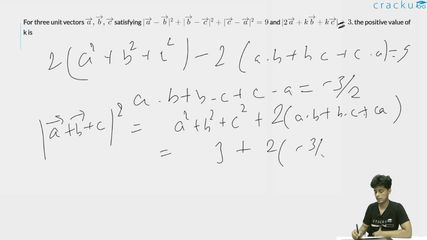
Expanding each squared difference gives $$|\vec{a} - \vec{b}|^2 = |\vec{a}|^2 - 2\vec{a} \cdot \vec{b} + |\vec{b}|^2 = 2 - 2\vec{a} \cdot \vec{b}$$, and similarly for the other pairs. Summing these three expressions yields $$6 - 2(\vec{a} \cdot \vec{b} + \vec{b} \cdot \vec{c} + \vec{c} \cdot \vec{a}) = 9$$, so $$\vec{a} \cdot \vec{b} + \vec{b} \cdot \vec{c} + \vec{c} \cdot \vec{a} = -\frac{3}{2}$$.
Next, observe that $$|\vec{a} + \vec{b} + \vec{c}|^2 = |\vec{a}|^2 + |\vec{b}|^2 + |\vec{c}|^2 + 2(\vec{a} \cdot \vec{b} + \vec{b} \cdot \vec{c} + \vec{c} \cdot \vec{a}) = 3 + 2\left(-\frac{3}{2}\right) = 0$$. Hence $$\vec{a} + \vec{b} + \vec{c} = \vec{0}$$, which implies $$\vec{b} + \vec{c} = -\vec{a}$$.
Using this result, one finds $$|2\vec{a} + k\vec{b} + k\vec{c}|^2 = |2\vec{a} + k(\vec{b} + \vec{c})|^2 = |2\vec{a} - k\vec{a}|^2 = (2 - k)^2|\vec{a}|^2 = (2 - k)^2$$. Therefore $$|2\vec{a} + k\vec{b} + k\vec{c}| = |2 - k|$$.
Setting this equal to 3 gives $$|2 - k| = 3$$, so $$2 - k = 3\implies k = -1$$ or $$2 - k = -3\implies k = 5$$. The positive value is $$k = 5$$.
Final answer: The required positive value of $$k$$ is 5.
Was this solution helpful?
Click on the Email ☝️ to Watch the Video Solution
Create a FREE account and get:
_1.webp)

Educational materials for JEE preparation

Ask our AI anything

AI can make mistakes. Please verify important information.
AI can make mistakes. Please verify important information.
