
Join Our JEE Preparation Group
Prep with like-minded aspirants; Get access to free daily tests and study material.
Sign in
Please select an account to continue using cracku.in
↓ →
Join Our JEE Preparation Group
Prep with like-minded aspirants; Get access to free daily tests and study material.
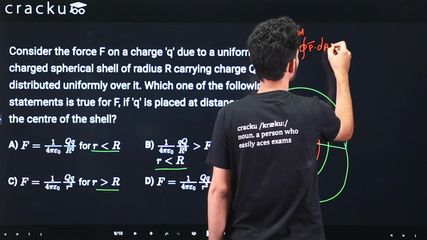
Consider the force F on a charge 'q' due to a uniformly charged spherical shell of radius R carrying charge Q distributed uniformly over it. Which one of the following statements is true for F, if 'q' is placed at distance r from the centre of the shell?
We start with Gauss’s law in integral form, stated as
$$\oint_{\text{closed}} \vec E\cdot d\vec A=\frac{q_{\text{enc}}}{\varepsilon_0}.$$
A uniformly charged thin spherical shell of radius $$R$$ carries a total charge $$Q$$ spread evenly over its surface. We place the test charge $$q$$ at a distance $$r$$ from the centre of the shell and look for the electrostatic force $$\vec F$$ acting on it.
Because the shell is spherically symmetric, the electric field at any point depends only on the distance from the centre. We therefore choose a concentric spherical Gaussian surface of radius $$r$$. On this Gaussian surface, the magnitude of the field $$E(r)$$ is the same everywhere and is directed radially. The area element $$d\vec A$$ is also radial, so the dot-product simplifies to $$\vec E\cdot d\vec A = E(r)\,dA$$. The closed-surface integral then becomes
$$\oint_{\text{closed}} \vec E\cdot d\vec A = E(r)\oint_{\text{closed}} dA = E(r)\,(4\pi r^{2}).$$
Now we distinguish the two possible locations of the test charge.
Case 1: $$r < R$$ (inside the shell)
For a point strictly inside the shell, the Gaussian surface of radius $$r$$ encloses no charge, because all the charge $$Q$$ resides on the shell’s surface, which lies outside our Gaussian sphere. Therefore
$$q_{\text{enc}} = 0.$$
Substituting into Gauss’s law gives
$$E(r)\,(4\pi r^{2}) = \frac{0}{\varepsilon_0}=0,$$
so
$$E(r)=0.$$
The force on the charge $$q$$ is obtained from $$\vec F = q\vec E$$. Because the field magnitude is zero, we have
$$F = q\,E(r)=0 \quad\text{for}\; r < R.$$
Case 2: $$r > R$$ (outside the shell)
When the Gaussian surface lies completely outside the shell, it encloses the entire charge $$Q$$. Thus
$$q_{\text{enc}} = Q.$$
Gauss’s law now gives
$$E(r)\,(4\pi r^{2}) = \frac{Q}{\varepsilon_0},$$
so
$$E(r)=\frac{Q}{4\pi\varepsilon_0\,r^{2}}.$$
The corresponding force on the test charge $$q$$ is
$$F = qE(r)=\frac{1}{4\pi\varepsilon_0}\frac{Qq}{r^{2}}\quad\text{for}\; r > R.$$
Summarising the results:
$$F = 0 \quad\text{for}\; r < R,$$
$$F = \frac{1}{4\pi\varepsilon_0}\frac{Qq}{r^{2}} \quad\text{for}\; r > R.$$
We now compare these findings with each option:
Option A asserts a non-zero constant force $$\dfrac{1}{4\pi\varepsilon_0}\dfrac{Qq}{R^{2}}$$ for $$r < R$$, but we have just shown that the force is zero inside, so Option A is false.
Option B claims $$\dfrac{1}{4\pi\varepsilon_0}\dfrac{Qq}{R^{2}} > F > 0$$ for $$r < R$$. Since the true value of $$F$$ inside is exactly zero, the inequality is violated; hence Option B is also false.
Option C states $$F=\dfrac{1}{4\pi\varepsilon_0}\dfrac{Qq}{r^{2}}$$ for $$r > R$$, which matches the expression we derived. Therefore, Option C is correct.
Option D maintains the same expression for all values of $$r$$, but we know it fails for $$r < R$$, so Option D is incorrect.
Hence, the correct answer is Option C.
Was this solution helpful?
Click on the Email ☝️ to Watch the Video Solution
Create a FREE account and get:
_1.webp)

Educational materials for JEE preparation

Ask our AI anything

AI can make mistakes. Please verify important information.
AI can make mistakes. Please verify important information.


