
Join Our JEE Preparation Group
Prep with like-minded aspirants; Get access to free daily tests and study material.
Sign in
Please select an account to continue using cracku.in
↓ →
Join Our JEE Preparation Group
Prep with like-minded aspirants; Get access to free daily tests and study material.
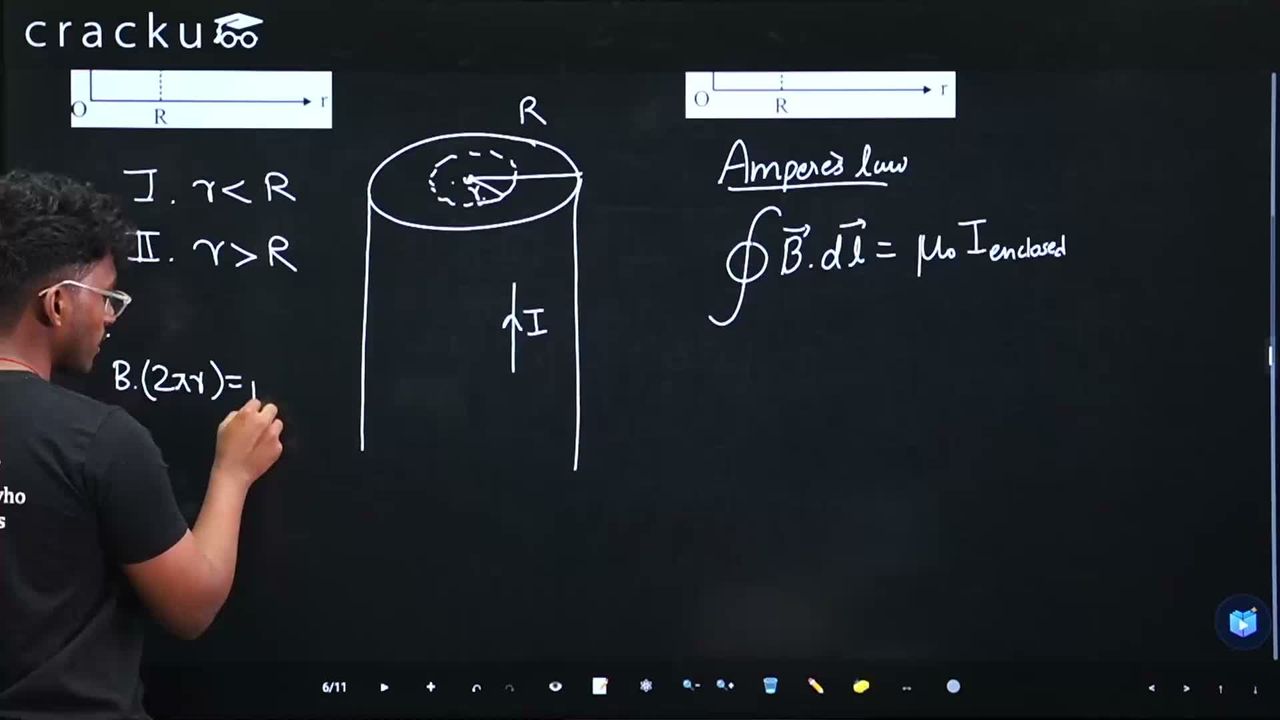
An infinitely long hollow conducting cylinder with radius $$R$$ carries a uniform current along its surface. Choose the correct representation of magnetic field $$(B)$$ as a function of radial distance $$(r)$$ from the axis of cylinder.
We need to find the magnetic field $$B$$ as a function of radial distance $$r$$ from the axis of an infinitely long hollow conducting cylinder of radius $$R$$ that carries a uniform current along its surface.
We apply Ampere's Law: $$\oint \vec{B} \cdot d\vec{l} = \mu_0 I_{\text{enc}}$$.
For $$r < R$$: Choose a circular Amperian loop of radius $$r < R$$ centred on the axis. Since the current flows only on the surface at $$r = R$$, this loop encloses zero current. By Ampere's Law: $$B(2\pi r) = 0$$, so $$B = 0$$ for all $$r < R$$.
For $$r > R$$: Choose a circular Amperian loop of radius $$r > R$$. This loop encloses the entire surface current $$I$$. By Ampere's Law: $$B(2\pi r) = \mu_0 I$$, giving $$B = \dfrac{\mu_0 I}{2\pi r}$$, which decreases as $$\dfrac{1}{r}$$.
The correct graph shows $$B = 0$$ for $$r < R$$ and $$B \propto \dfrac{1}{r}$$ for $$r > R$$.
The answer is Option D.
Was this solution helpful?
Click on the Email ☝️ to Watch the Video Solution
Create a FREE account and get:
_1.webp)

Educational materials for JEE preparation

Ask our AI anything

AI can make mistakes. Please verify important information.
AI can make mistakes. Please verify important information.
