
Join Our JEE Preparation Group
Prep with like-minded aspirants; Get access to free daily tests and study material.
Sign in
Please select an account to continue using cracku.in
↓ →
Join Our JEE Preparation Group
Prep with like-minded aspirants; Get access to free daily tests and study material.
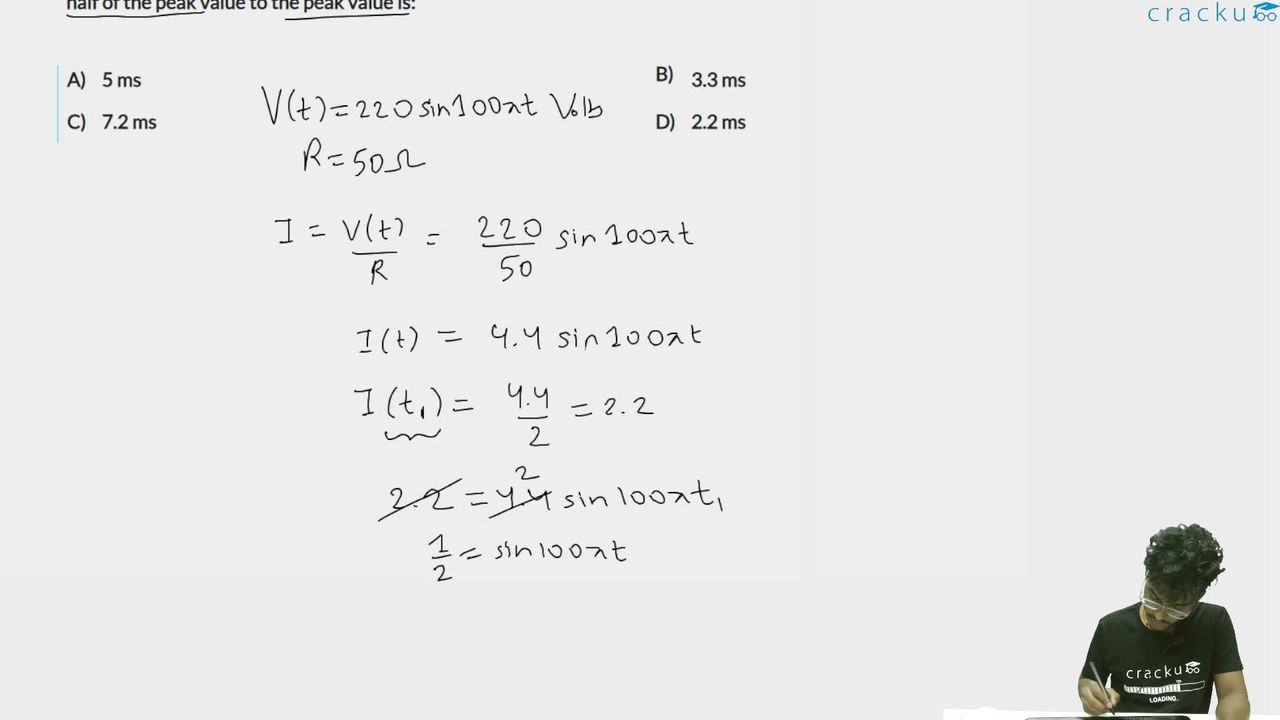
An alternating voltage $$V(t) = 220\sin 100\pi t$$ volt is applied to a purely resistive load of $$50 \Omega$$. The time taken for the current to rise from half of the peak value to the peak value is:
$$V(t) = 220\sin(100\pi t)$$, $$R = 50\Omega$$.
Peak current: $$I_0 = V_0/R = 220/50 = 4.4$$ A.
Current: $$I = I_0\sin(100\pi t)$$.
Half peak: $$I_0/2$$ when $$\sin(100\pi t_1) = 1/2 \Rightarrow 100\pi t_1 = \pi/6 \Rightarrow t_1 = \frac{1}{600}$$ s.
Peak: when $$\sin(100\pi t_2) = 1 \Rightarrow 100\pi t_2 = \pi/2 \Rightarrow t_2 = \frac{1}{200}$$ s.
$$\Delta t = t_2 - t_1 = \frac{1}{200} - \frac{1}{600} = \frac{3-1}{600} = \frac{2}{600} = \frac{1}{300}$$ s $$= 3.33$$ ms.
The answer is Option (2): $$\boxed{3.3 \text{ ms}}$$.
Was this solution helpful?
Click on the Email ☝️ to Watch the Video Solution
Create a FREE account and get:
_1.webp)

Educational materials for JEE preparation

Ask our AI anything

AI can make mistakes. Please verify important information.
AI can make mistakes. Please verify important information.
