
Join Our JEE Preparation Group
Prep with like-minded aspirants; Get access to free daily tests and study material.
Sign in
Please select an account to continue using cracku.in
↓ →
Join Our JEE Preparation Group
Prep with like-minded aspirants; Get access to free daily tests and study material.
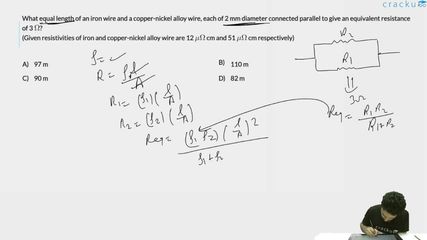
What equal length of an iron wire and a copper-nickel alloy wire, each of 2 mm diameter connected parallel to give an equivalent resistance of 3 $$\Omega$$?
(Given resistivities of iron and copper-nickel alloy wire are 12 $$\mu\Omega$$ cm and 51 $$\mu\Omega$$ cm respectively)
We start by recalling the resistance formula for a uniform wire:
$$R=\rho\frac{L}{A}$$
where $$\rho$$ is the resistivity, $$L$$ is the length and $$A$$ is the cross-sectional area.
The two wires (iron and copper-nickel alloy) have
diameter $$d = 2\ \text{mm}=0.2\ \text{cm}\;,$$
so the radius is
$$r=\frac{d}{2}=1\ \text{mm}=0.1\ \text{cm}.$$
The area of a circle is $$A=\pi r^{2},$$ hence
$$A=\pi(0.1\ \text{cm})^{2}=\pi(0.01)\ \text{cm}^{2}=0.01\pi\ \text{cm}^{2}.$$
Both wires are required to have the same unknown length $$L$$ and are connected in parallel. For two resistances $$R_{1}$$ and $$R_{2}$$ in parallel we use
$$\frac{1}{R_{\text{eq}}}=\frac{1}{R_{1}}+\frac{1}{R_{2}}.$$
The given resistivities are
$$\rho_{\text{Fe}} = 12\ \mu\Omega\text{ cm}=12\times10^{-6}\ \Omega\text{ cm},$$
$$\rho_{\text{Cu-Ni}} = 51\ \mu\Omega\text{ cm}=51\times10^{-6}\ \Omega\text{ cm}.$$
Therefore the individual resistances are
$$R_{\text{Fe}}=\rho_{\text{Fe}}\frac{L}{A},\qquad R_{\text{Cu-Ni}}=\rho_{\text{Cu-Ni}}\frac{L}{A}.$$
The equivalent resistance is given to be
$$R_{\text{eq}} = 3\ \Omega.$$
Substituting the expressions for the two resistances into the parallel-combination formula, we get
$$\frac{1}{3}=\frac{1}{\rho_{\text{Fe}}\dfrac{L}{A}}+\frac{1}{\rho_{\text{Cu-Ni}}\dfrac{L}{A}} =\frac{A}{L}\left(\frac{1}{\rho_{\text{Fe}}}+\frac{1}{\rho_{\text{Cu-Ni}}}\right).$$
Now we isolate $$L$$:
$$\frac{1}{3}=\frac{A}{L}\left(\frac{\rho_{\text{Fe}}+\rho_{\text{Cu-Ni}}}{\rho_{\text{Fe}}\rho_{\text{Cu-Ni}}}\right)$$
$$\Rightarrow\;L=3A\frac{\rho_{\text{Fe}}+\rho_{\text{Cu-Ni}}}{\rho_{\text{Fe}}\rho_{\text{Cu-Ni}}}.$$
We substitute the numerical values:
$$A = 0.01\pi\ \text{cm}^{2},\qquad \rho_{\text{Fe}} = 12\times10^{-6}\ \Omega\text{ cm},\qquad \rho_{\text{Cu-Ni}} = 51\times10^{-6}\ \Omega\text{ cm}.$$
First, add the resistivities:
$$\rho_{\text{Fe}}+\rho_{\text{Cu-Ni}}=(12+51)\times10^{-6}=63\times10^{-6}\ \Omega\text{ cm}.$$
Next, multiply them:
$$\rho_{\text{Fe}}\rho_{\text{Cu-Ni}}= (12\times10^{-6})(51\times10^{-6})=612\times10^{-12}\ \Omega^{2}\text{ cm}^{2}.$$
Insert everything into the length expression:
$$L = 3(0.01\pi)\frac{63\times10^{-6}}{612\times10^{-12}} =0.03\pi\cdot63\times10^{-6}\times\frac{1}{612\times10^{-12}}.$$
Simplifying the powers of ten:
$$\frac{10^{-6}}{10^{-12}} = 10^{6},$$
so
$$L = 0.03\pi\cdot63\cdot10^{6}\times\frac{1}{612}.$$
Compute the numerical factor:
$$0.03\times63 = 1.89,$$
$$\frac{1.89}{612}=0.0030882,$$
$$0.0030882\times\pi\approx0.009702.$$
Therefore
$$L\approx0.009702\times10^{6}\ \text{cm}=9702\ \text{cm}.$$
Finally convert centimetres to metres:
$$L=\frac{9702}{100}\ \text{m}\approx97.0\ \text{m}.$$
Hence, the correct answer is Option A.
Was this solution helpful?
Click on the Email ☝️ to Watch the Video Solution
Create a FREE account and get:
_1.webp)

Educational materials for JEE preparation

Ask our AI anything

AI can make mistakes. Please verify important information.
AI can make mistakes. Please verify important information.
