
Join Our JEE Preparation Group
Prep with like-minded aspirants; Get access to free daily tests and study material.
Sign in
Please select an account to continue using cracku.in
↓ →
Join Our JEE Preparation Group
Prep with like-minded aspirants; Get access to free daily tests and study material.
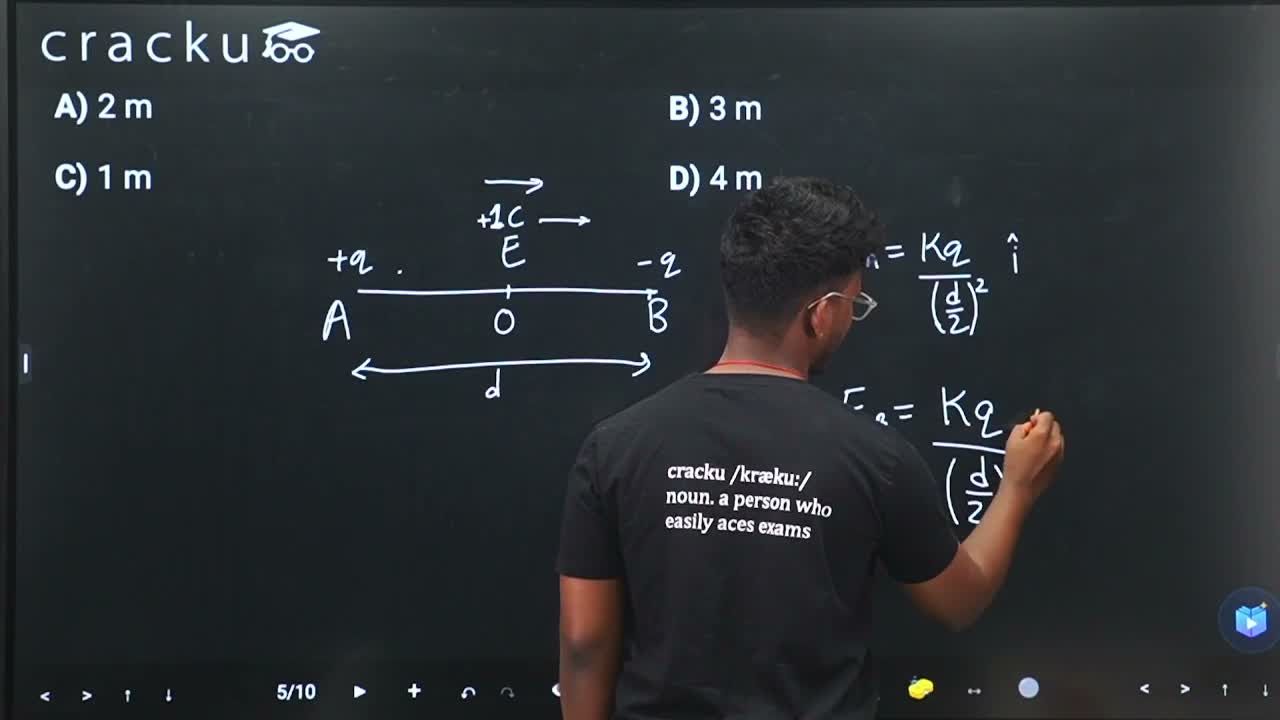
Two point charges $$A$$ and $$B$$ of magnitude $$+8 \times 10^{-6}$$C and $$-8 \times 10^{-6}$$C respectively are placed at a distance $$d$$ apart. The electric field at the middle point $$O$$ between the charges is $$6.4 \times 10^4$$ N C$$^{-1}$$. The distance '$$d$$' between the point charges $$A$$ and $$B$$ is
Two point charges $$A = +8 \times 10^{-6}$$ C and $$B = -8 \times 10^{-6}$$ C are placed at a distance $$d$$ apart. The electric field at the midpoint $$O$$ is $$6.4 \times 10^4$$ N C$$^{-1}$$. We need to find the distance $$d$$.
Understand the configuration and direction of electric fields at the midpoint.
The midpoint $$O$$ is at a distance of $$d/2$$ from each charge.
The electric field due to the positive charge $$A$$ at point $$O$$ points away from $$A$$ (i.e., from $$A$$ toward $$B$$).
The electric field due to the negative charge $$B$$ at point $$O$$ points toward $$B$$ (i.e., also from $$A$$ toward $$B$$).
Since both fields point in the same direction, they add up.
Calculate the electric field due to each charge at the midpoint.
The magnitude of the electric field due to charge $$A$$ at the midpoint:
$$E_A = \frac{kq}{(d/2)^2} = \frac{4kq}{d^2}$$
Similarly, the magnitude of the electric field due to charge $$B$$ at the midpoint:
$$E_B = \frac{kq}{(d/2)^2} = \frac{4kq}{d^2}$$
where $$q = 8 \times 10^{-6}$$ C and $$k = 9 \times 10^9$$ N m$$^2$$ C$$^{-2}$$.
Write the total electric field at the midpoint.
Since both fields are in the same direction:
$$E_{total} = E_A + E_B = \frac{4kq}{d^2} + \frac{4kq}{d^2} = \frac{8kq}{d^2}$$
Substitute the known values and solve for $$d$$.
$$6.4 \times 10^4 = \frac{8 \times 9 \times 10^9 \times 8 \times 10^{-6}}{d^2}$$
Calculating the numerator:
$$8 \times 9 \times 10^9 \times 8 \times 10^{-6} = 8 \times 72 \times 10^{3} = 576 \times 10^{3} = 5.76 \times 10^5$$
So:
$$6.4 \times 10^4 = \frac{5.76 \times 10^5}{d^2}$$
Solve for $$d$$.
$$d^2 = \frac{5.76 \times 10^5}{6.4 \times 10^4} = \frac{576}{64} = 9$$
$$d = 3 \text{ m}$$
The correct answer is Option B.
Was this solution helpful?
Click on the Email ☝️ to Watch the Video Solution
Create a FREE account and get:
_1.webp)

Educational materials for JEE preparation

Ask our AI anything

AI can make mistakes. Please verify important information.
AI can make mistakes. Please verify important information.
