
Join Our JEE Preparation Group
Prep with like-minded aspirants; Get access to free daily tests and study material.
Sign in
Please select an account to continue using cracku.in
↓ →
Join Our JEE Preparation Group
Prep with like-minded aspirants; Get access to free daily tests and study material.
The electric potential at the centre of two concentric half rings of radii $$R_1$$ and $$R_2$$, having same linear charge density $$\lambda$$ is
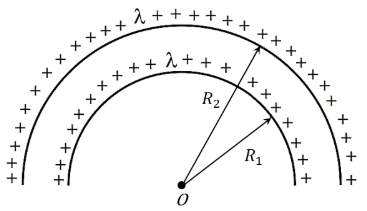
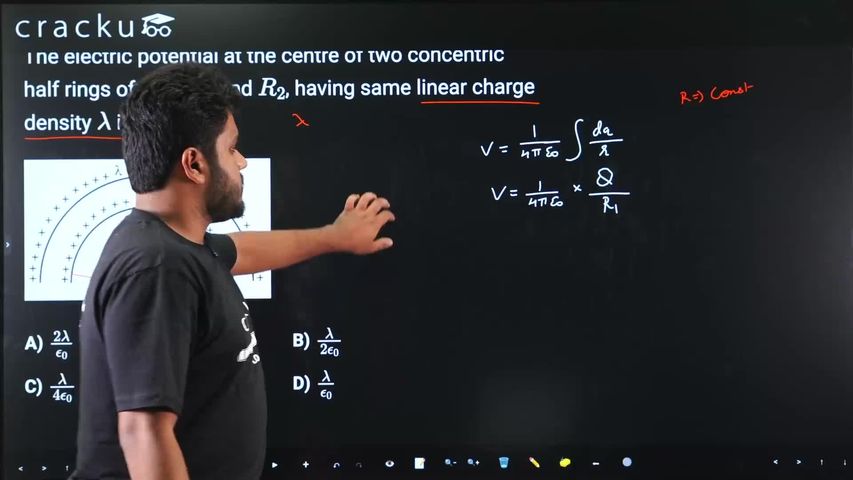
Potential due to a charged arc at its centre is
$$V=\frac{1}{4\pi\varepsilon_0}\int\frac{dq}{R}$$
Since RRR is constant for an arc,
$$V=\frac{1}{4\pi\varepsilon_0}\frac{Q}{R}$$
For a half ring of radius R, length is
$$\pi R$$
So charge on it is
$$\left(Q=\lambda(\pi R\right)$$
Thus potential due to one half ring:
$$V=\frac{1}{4\pi\varepsilon_0}\frac{\lambda\pi R}{R}$$
$$=\frac{\lambda\pi}{4\pi\varepsilon_0}$$
$$=\frac{\lambda}{4\varepsilon_0}$$
Interesting result: it is independent of radius.
So each half ring contributes
$$\frac{\lambda}{4\varepsilon_0}$$
For two concentric half rings, potentials add:
$$V=\frac{\lambda}{4\varepsilon_0}+\frac{\lambda}{4\varepsilon_0}$$
$$V=\frac{\lambda}{2\varepsilon_0}$$
Was this solution helpful?
Click on the Email ☝️ to Watch the Video Solution
Create a FREE account and get:
_1.webp)

Educational materials for JEE preparation

Ask our AI anything

AI can make mistakes. Please verify important information.
AI can make mistakes. Please verify important information.
