 JEE WhatsApp Group
Sign in
Please select an account to continue using cracku.in
↓ →
JEE WhatsApp Group

Join Our JEE Preparation Group
Prep with like-minded aspirants; Get access to free daily tests and study material.
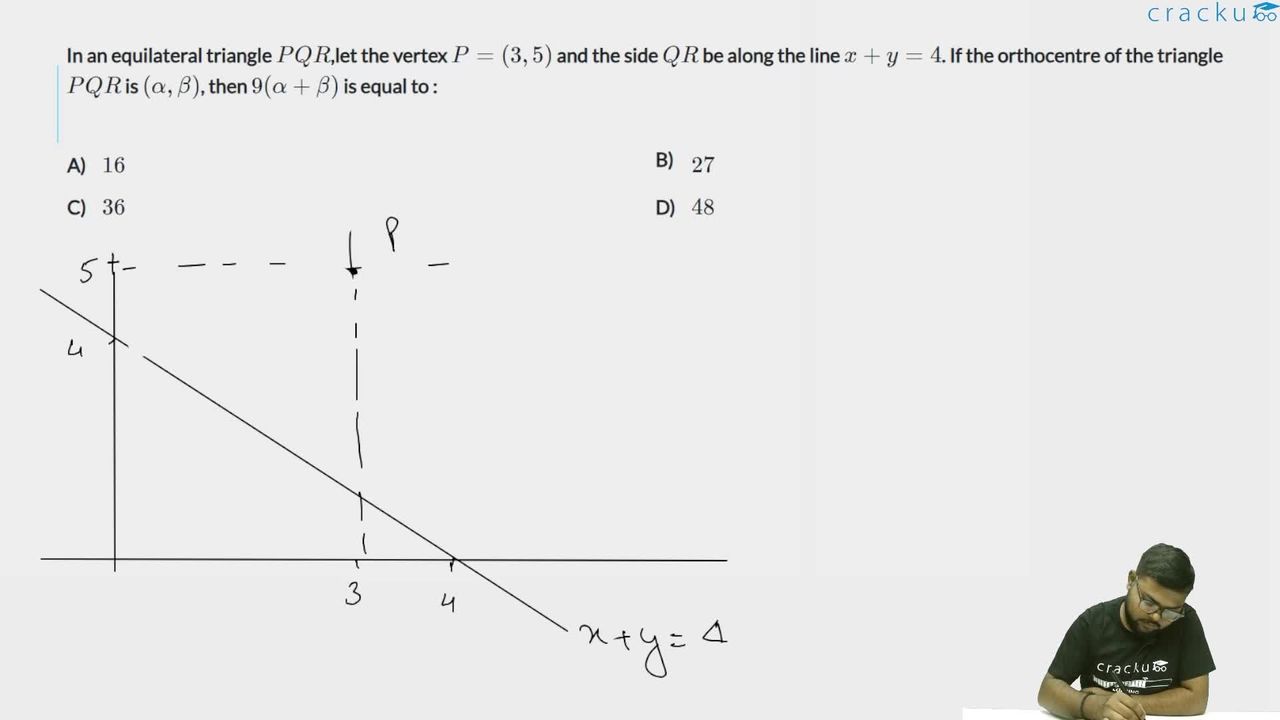
In an equilateral triangle $$PQR$$,let the vertex $$P = (3, 5)$$ and the side $$QR$$ be along the line $$x + y = 4$$. If the orthocentre of the triangle $$PQR$$ is $$(\alpha, \beta)$$, then $$9(\alpha + \beta)$$ is equal to :
To solve this problem, we need to use a special property of equilateral triangles: the orthocenter, circumcenter, and centroid all coincide at the same point.
In an equilateral triangle, the orthocenter $$H(\alpha, \beta)$$ is the same as the centroid. The centroid divides the median (the altitude from $$P$$ to side $$QR$$) in a ratio of $$2:1$$.
Let $$M(x_1, y_1)$$ be the foot of the perpendicular from vertex $$P(3, 5)$$ to the line $$x + y - 4 = 0$$. This point $$M$$ is the midpoint of side $$QR$$.
Using the formula for the foot of the perpendicular:
$$\frac{x_1 - x}{a} = \frac{y_1 - y}{b} = -\frac{(ax + by + c)}{a^2 + b^2}$$
$$\frac{x_1 - 3}{1} = \frac{y_1 - 5}{1} = -\frac{(3 + 5 - 4)}{1^2 + 1^2} = -\frac{4}{2} = -2$$
Solving for $$x_1$$ and $$y_1$$:
So, $$M = (1, 3)$$.
The orthocenter $$H(\alpha, \beta)$$ lies on the segment $$PM$$ and divides it in the ratio $$2:1$$ (measured from the vertex $$P$$).
Using the section formula for $$P(3, 5)$$ and $$M(1, 3)$$ with ratio $$m:n = 2:1$$:
$$\alpha = \frac{m x_1 + n x}{m + n} = \frac{2(1) + 1(3)}{2 + 1} = \frac{5}{3}$$
$$\beta = \frac{m y_1 + n y}{m + n} = \frac{2(3) + 1(5)}{2 + 1} = \frac{11}{3}$$
First, find the sum of $$\alpha$$ and $$\beta$$:
$$\alpha + \beta = \frac{5}{3} + \frac{11}{3} = \frac{16}{3}$$
Now, multiply by 9:
$$9(\alpha + \beta) = 9 \times \frac{16}{3} = 3 \times 16 = 48$$
Final Answer: 48 (Option D)
Click on the Email ☝️ to Watch the Video Solution
Create a FREE account and get:


Educational materials for JEE preparation

Ask our AI anything

AI can make mistakes. Please verify important information.
AI can make mistakes. Please verify important information.
