
Join Our JEE Preparation Group
Prep with like-minded aspirants; Get access to free daily tests and study material.
Sign in
Please select an account to continue using cracku.in
↓ →
Join Our JEE Preparation Group
Prep with like-minded aspirants; Get access to free daily tests and study material.
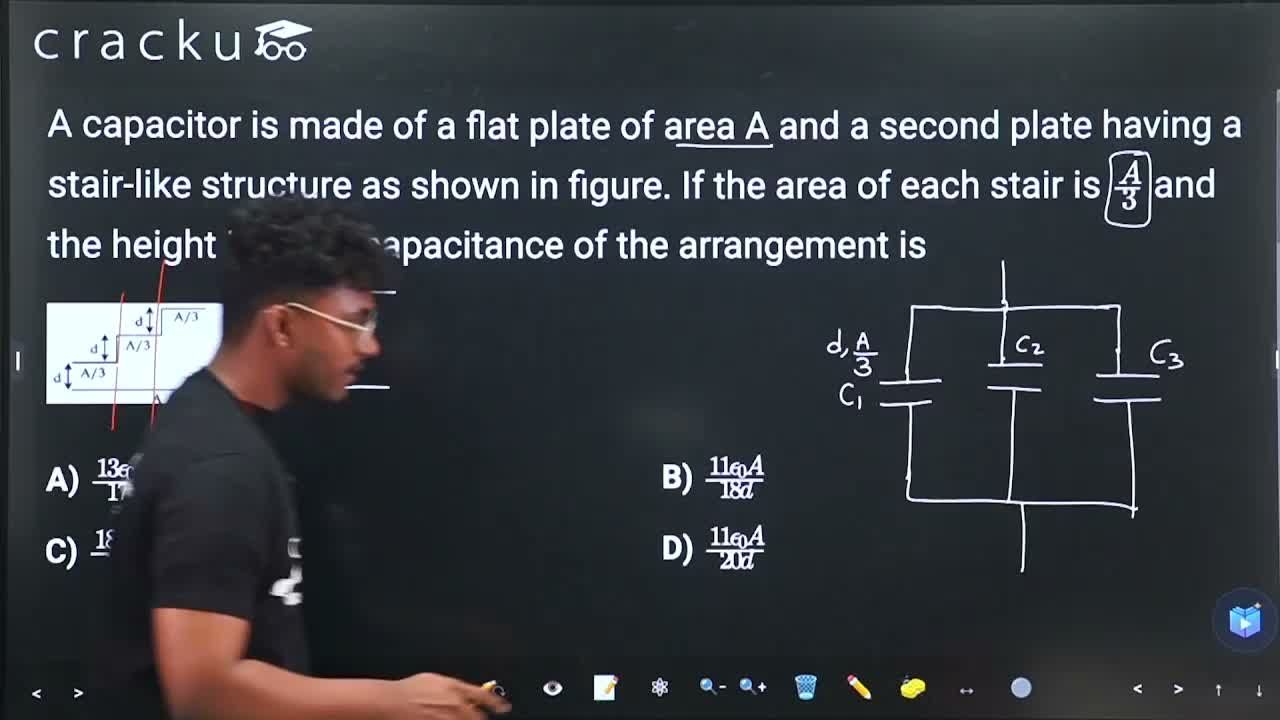
A capacitor is made of a flat plate of area A and a second plate having a stair-like structure as shown in figure. If the area of each stair is $$\frac{A}{3}$$ and the height is $$d$$, the capacitance of the arrangement is
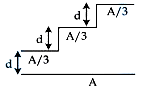
step 1: understand geometry
the bottom plate is flat (area A)
the top plate has 3 steps, each of area A/3
their separations from bottom plate are:
• lowest step → distance = d
• middle step → distance = 2d
• top step → distance = 3d
step 2: treat as capacitors
each step forms a capacitor with the bottom plate
all are connected in parallel (same two plates → same potential difference)
step 3: capacitance of each
$$C_1=\frac{\varepsilon_0(A/3)}{d}$$
$$C_2=\frac{\varepsilon_0(A/3)}{2d}$$
$$C_3=\frac{\varepsilon_0(A/3)}{3d}$$
step 4: total capacitance (parallel)
$$C=C_1+C_2+C_3$$
$$=\frac{\varepsilon_0A}{3d}\left(1+\frac{1}{2}+\frac{1}{3}\right)$$
$$=\frac{\varepsilon_0A}{3d}\cdot\frac{11}{6}$$
Was this solution helpful?
Click on the Email ☝️ to Watch the Video Solution
Create a FREE account and get:
_1.webp)

Educational materials for JEE preparation

Ask our AI anything

AI can make mistakes. Please verify important information.
AI can make mistakes. Please verify important information.
