
Join Our JEE Preparation Group
Prep with like-minded aspirants; Get access to free daily tests and study material.
Sign in
Please select an account to continue using cracku.in
↓ →
Join Our JEE Preparation Group
Prep with like-minded aspirants; Get access to free daily tests and study material.
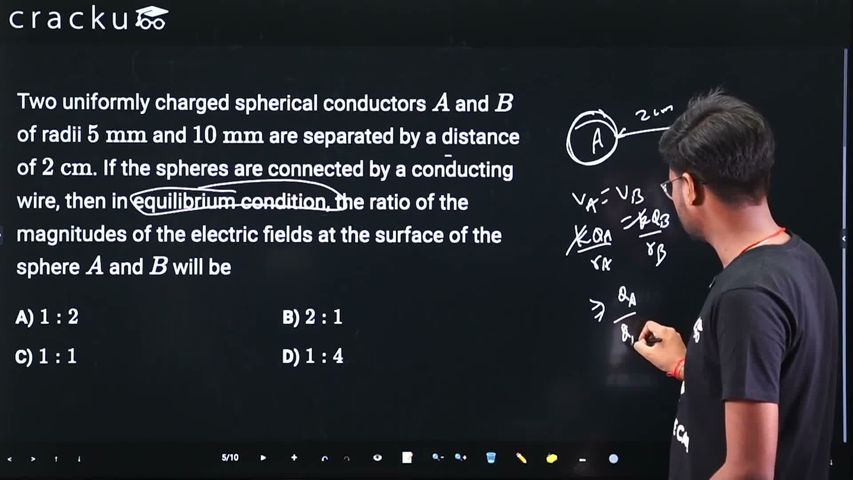
Two uniformly charged spherical conductors $$A$$ and $$B$$ of radii $$5 \text{ mm}$$ and $$10 \text{ mm}$$ are separated by a distance of $$2 \text{ cm}$$. If the spheres are connected by a conducting wire, then in equilibrium condition, the ratio of the magnitudes of the electric fields at the surface of the sphere $$A$$ and $$B$$ will be
Two conducting spheres $$A$$ (radius $$r_A = 5 \text{ mm}$$) and $$B$$ (radius $$r_B = 10 \text{ mm}$$) are connected by a conducting wire, so they reach the same potential in equilibrium. Thus $$V_A = V_B$$ gives $$\dfrac{kQ_A}{r_A} = \dfrac{kQ_B}{r_B}$$. From this, $$\dfrac{Q_A}{Q_B} = \dfrac{r_A}{r_B} = \dfrac{5}{10} = \dfrac{1}{2}$$.
The electric field at the surface of a conducting sphere is $$E = \dfrac{kQ}{r^2} = \dfrac{V}{r}$$. Since both spheres are at the same potential $$V$$, $$\dfrac{E_A}{E_B} = \dfrac{V/r_A}{V/r_B} = \dfrac{r_B}{r_A} = \dfrac{10}{5} = \dfrac{2}{1}$$. Therefore, $$E_A : E_B = 2 : 1$$.
The correct answer is Option B: $$2:1$$.
Was this solution helpful?
Click on the Email ☝️ to Watch the Video Solution
Create a FREE account and get:
_1.webp)

Educational materials for JEE preparation

Ask our AI anything

AI can make mistakes. Please verify important information.
AI can make mistakes. Please verify important information.
