
Join Our JEE Preparation Group
Prep with like-minded aspirants; Get access to free daily tests and study material.
Sign in
Please select an account to continue using cracku.in
↓ →
Join Our JEE Preparation Group
Prep with like-minded aspirants; Get access to free daily tests and study material.
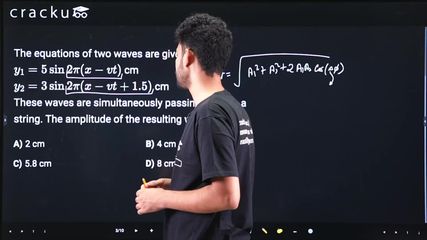
The equations of two waves are given by :
$$y_1 = 5 \sin 2\pi(x - vt)$$ cm
$$y_2 = 3 \sin 2\pi(x - vt + 1.5)$$ cm
These waves are simultaneously passing through a string. The amplitude of the resulting wave is :
We are given two waves:
$$ y_1 = 5\sin 2\pi(x - vt) \text{ cm} $$
$$ y_2 = 3\sin 2\pi(x - vt + 1.5) \text{ cm} $$
The phase of $$y_1$$ is $$\phi_1 = 2\pi(x - vt)$$, and the phase of $$y_2$$ is $$\phi_2 = 2\pi(x - vt + 1.5) = 2\pi(x - vt) + 2\pi \times 1.5$$. Thus, the phase difference is:
$$ \Delta\phi = 2\pi \times 1.5 = 3\pi $$
Since $$3\pi = 2\pi + \pi$$, the effective phase difference is:
$$ \Delta\phi = \pi \text{ (i.e., the waves are in anti-phase)} $$
The formula for resultant amplitude when two waves superpose is:
$$ A = \sqrt{A_1^2 + A_2^2 + 2A_1 A_2 \cos(\Delta\phi)} $$
Substituting the given values:
$$ A = \sqrt{5^2 + 3^2 + 2(5)(3)\cos(\pi)} $$
$$ A = \sqrt{25 + 9 + 30 \times (-1)} $$
$$ A = \sqrt{25 + 9 - 30} = \sqrt{4} = 2 \text{ cm} $$
Therefore, the correct answer is Option A.
Was this solution helpful?
Click on the Email ☝️ to Watch the Video Solution
Create a FREE account and get:
_1.webp)

Educational materials for JEE preparation

Ask our AI anything

AI can make mistakes. Please verify important information.
AI can make mistakes. Please verify important information.
