
Join Our JEE Preparation Group
Prep with like-minded aspirants; Get access to free daily tests and study material.
Sign in
Please select an account to continue using cracku.in
↓ →
Join Our JEE Preparation Group
Prep with like-minded aspirants; Get access to free daily tests and study material.
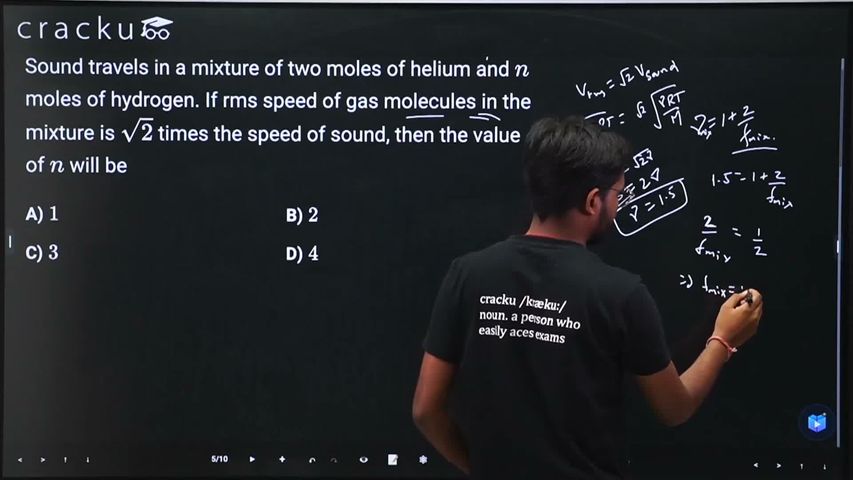
Sound travels in a mixture of two moles of helium and $$n$$ moles of hydrogen. If rms speed of gas molecules in the mixture is $$\sqrt{2}$$ times the speed of sound, then the value of $$n$$ will be
Sound travels in a mixture of 2 moles of helium (He) and $$n$$ moles of hydrogen (H$$_2$$). We are given that the rms speed of gas molecules in the mixture is $$\sqrt{2}$$ times the speed of sound in the mixture.
Relate rms speed and speed of sound to find $$\gamma_{mix}$$.
The rms speed and speed of sound in a gas are:
$$v_{rms} = \sqrt{\frac{3RT}{M_{mix}}}, \quad v_{sound} = \sqrt{\frac{\gamma_{mix} RT}{M_{mix}}}$$
Given $$v_{rms} = \sqrt{2} \times v_{sound}$$, we square both sides:
$$\frac{3RT}{M_{mix}} = 2 \times \frac{\gamma_{mix} RT}{M_{mix}}$$
Cancelling $$\frac{RT}{M_{mix}}$$ from both sides:
$$3 = 2\gamma_{mix}$$
$$\gamma_{mix} = \frac{3}{2}$$
Determine the specific heats of the individual gases.
Helium is monatomic with degrees of freedom $$f_{He} = 3$$:
$$C_{v,He} = \frac{3}{2}R, \quad C_{p,He} = \frac{5}{2}R$$
Hydrogen is diatomic with degrees of freedom $$f_{H_2} = 5$$:
$$C_{v,H_2} = \frac{5}{2}R, \quad C_{p,H_2} = \frac{7}{2}R$$
Calculate $$C_{v,mix}$$ and $$C_{p,mix}$$ for the mixture.
For a mixture of ideal gases, the molar specific heats are weighted by the number of moles:
$$C_{v,mix} = \frac{n_{He} \cdot C_{v,He} + n_{H_2} \cdot C_{v,H_2}}{n_{He} + n_{H_2}} = \frac{2 \times \frac{3}{2}R + n \times \frac{5}{2}R}{2 + n} = \frac{3R + \frac{5nR}{2}}{2 + n} = \frac{R(6 + 5n)}{2(2 + n)}$$
$$C_{p,mix} = \frac{n_{He} \cdot C_{p,He} + n_{H_2} \cdot C_{p,H_2}}{n_{He} + n_{H_2}} = \frac{2 \times \frac{5}{2}R + n \times \frac{7}{2}R}{2 + n} = \frac{5R + \frac{7nR}{2}}{2 + n} = \frac{R(10 + 7n)}{2(2 + n)}$$
Apply the condition $$\gamma_{mix} = \frac{3}{2}$$.
$$\gamma_{mix} = \frac{C_{p,mix}}{C_{v,mix}} = \frac{10 + 7n}{6 + 5n} = \frac{3}{2}$$
Cross-multiplying:
$$2(10 + 7n) = 3(6 + 5n)$$
$$20 + 14n = 18 + 15n$$
$$20 - 18 = 15n - 14n$$
$$n = 2$$
Verification: With $$n = 2$$: $$\gamma_{mix} = \frac{10 + 14}{6 + 10} = \frac{24}{16} = \frac{3}{2}$$ $$\checkmark$$
The correct answer is Option B: $$2$$.
Was this solution helpful?
Click on the Email ☝️ to Watch the Video Solution
Create a FREE account and get:
_1.webp)

Educational materials for JEE preparation

Ask our AI anything

AI can make mistakes. Please verify important information.
AI can make mistakes. Please verify important information.
