
Join Our JEE Preparation Group
Prep with like-minded aspirants; Get access to free daily tests and study material.
Sign in
Please select an account to continue using cracku.in
↓ →
Join Our JEE Preparation Group
Prep with like-minded aspirants; Get access to free daily tests and study material.
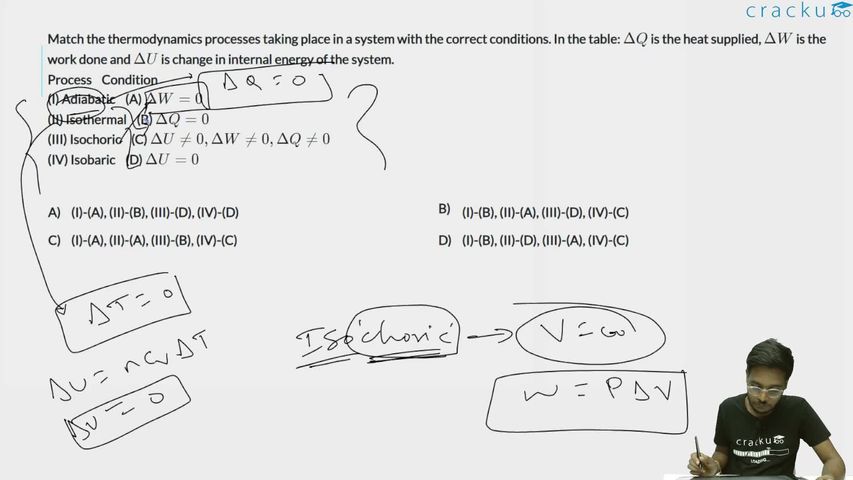
Match the thermodynamics processes taking place in a system with the correct conditions. In the table: $$\Delta Q$$ is the heat supplied, $$\Delta W$$ is the work done and $$\Delta U$$ is change in internal energy of the system.
Process Condition
(I) Adiabatic (A) $$\Delta W = 0$$
(II) Isothermal (B) $$\Delta Q = 0$$
(III) Isochoric (C) $$\Delta U \neq 0, \Delta W \neq 0, \Delta Q \neq 0$$
(IV) Isobaric (D) $$\Delta U = 0$$
We start from the first law of thermodynamics, which in differential form is stated as $$\Delta Q=\Delta U+\Delta W,$$ where $$\Delta Q$$ is the heat supplied to the system, $$\Delta U$$ is the change in internal energy and $$\Delta W$$ is the work done by the system.
Now we examine every thermodynamic process one by one and translate its defining property into conditions on $$\Delta Q,\;\Delta U,\;\Delta W.$
For an adiabatic process the defining statement is “no heat enters or leaves the system.” Mathematically this means $$\Delta Q=0.$$ Substituting $$\Delta Q=0$$ in the first-law expression we get $$0=\Delta U+\Delta W,$$ so generally neither $$\Delta U$$ nor $$\Delta W$$ has to be zero, only their sum must vanish. Hence the sole obligatory condition is $$\Delta Q=0,$$ which is condition (B).
For an isothermal process carried out on an ideal gas the temperature stays constant. The internal energy of an ideal gas depends only on temperature, so constant temperature immediately gives $$\Delta U=0.$$ Putting $$\Delta U=0$$ into $$\Delta Q=\Delta U+\Delta W$$ yields $$\Delta Q=\Delta W,$$ but neither of these terms is forced to be zero. Thus the characteristic condition is $$\Delta U=0,$$ corresponding to condition (D).
For an isochoric process the volume remains fixed, so the system cannot do pressure-volume work. The work term is $$\Delta W = P\,\Delta V,$$ and since $$\Delta V=0,$$ we have $$\Delta W=0.$$ Substituting $$\Delta W=0$$ in the first law gives $$\Delta Q=\Delta U,$$ with both quantities in general non-zero. Therefore the key condition is $$\Delta W=0,$$ i.e. condition (A).
For an isobaric process the pressure stays constant but the volume can change. Hence $$\Delta V\neq 0,$$ so $$\Delta W=P\,\Delta V\neq 0.$$ Temperature usually changes, making $$\Delta U\neq 0,$$ and because both $$\Delta U$$ and $$\Delta W$$ are non-zero, the heat supplied $$\Delta Q=\Delta U+\Delta W$$ is also non-zero. Thus all three changes are generally different from zero: $$\Delta U\neq 0,\;\Delta W\neq 0,\;\Delta Q\neq 0,$$ matching condition (C).
Collecting the matches we have:
$$ \begin{aligned} \text{(I) Adiabatic} &\longrightarrow \text{(B)} \\[4pt] \text{(II) Isothermal} &\longrightarrow \text{(D)} \\[4pt] \text{(III) Isochoric} &\longrightarrow \text{(A)} \\[4pt] \text{(IV) Isobaric} &\longrightarrow \text{(C)} \end{aligned} $$
This pattern corresponds exactly to Option D.
Hence, the correct answer is Option D.
Was this solution helpful?
Click on the Email ☝️ to Watch the Video Solution
Create a FREE account and get:
_1.webp)

Educational materials for JEE preparation

Ask our AI anything

AI can make mistakes. Please verify important information.
AI can make mistakes. Please verify important information.


