
Join Our JEE Preparation Group
Prep with like-minded aspirants; Get access to free daily tests and study material.
Sign in
Please select an account to continue using cracku.in
↓ →
Join Our JEE Preparation Group
Prep with like-minded aspirants; Get access to free daily tests and study material.
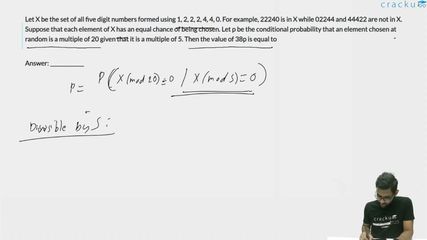
Let X be the set of all five digit numbers formed using 1, 2, 2, 2, 4, 4, 0. For example, 22240 is in X while 02244 and 44422 are not in X. Suppose that each element of X has an equal chance of being chosen. Let p be the conditional probability that an element chosen at random is a multiple of 20 given that it is a multiple of 5. Then the value of 38p is equal to
Correct Answer: 31
The multiset of available digits is $$\{0,1,2,2,2,4,4\}$$.
A member of $$X$$ is a 5-digit permutation of five of these digits, the left-most digit being non-zero.
Step 1 : Condition “multiple of 5’’
A number is a multiple of 5 only when its last digit is $$0$$ (the digit $$5$$ is not present).
Fix the units place as $$0$$. The remaining four positions must be filled with the digits of the multiset
$$\{1,2,2,2,4,4\}$$.
Step 2 : Count of all numbers ending in 0
Let $$a,b,c$$ be the numbers of $$1\,'\!s, 2\,'\!s, 4\,'\!s$$ used in the first four places.
They satisfy
$$a+b+c=4,\; 0\le a\le1,\;0\le b\le3,\;0\le c\le2.$$
For every triple $$(a,b,c)$$ the number of distinct arrangements is $$\dfrac{4!}{a!\,b!\,c!}.$$
Listing all admissible triples:
$$ \begin{array}{ccccl} a & b & c & \text{Digits used} & \text{Arrangements} \\ \hline 0 & 3 & 1 & 2,2,2,4 & \dfrac{4!}{3!\,1!}=4\\ 0 & 2 & 2 & 2,2,4,4 & \dfrac{4!}{2!\,2!}=6\\ 1 & 3 & 0 & 1,2,2,2 & \dfrac{4!}{1!\,3!}=4\\ 1 & 2 & 1 & 1,2,2,4 & \dfrac{4!}{1!\,2!\,1!}=12\\ 1 & 1 & 2 & 1,2,4,4 & \dfrac{4!}{1!\,1!\,2!}=12 \end{array} $$
Total 4-digit arrangements (hence total numbers ending with 0):
$$T = 4+6+4+12+12 = 38.$$
Step 3 : Extra condition for “multiple of 20’’
A number ending in $$0$$ is divisible by $$20$$ precisely when the tens digit (4th position) is even.
After fixing the unit digit as $$0$$ there is no second zero left, so the tens digit can only be $$2$$ or $$4$$.
Thus, the only disallowed case is when the tens digit equals $$1$$.
Case - Tens digit = 1
Choose $$1$$ for the 4th position. The remaining multiset for the first three places is $$\{2,2,2,4,4\}$$.
All 3-digit permutations from this multiset are:
• 2,2,2 (1 way)
• 2,2,4 (3!/2! = 3 ways)
• 2,4,4 (3!/2! = 3 ways)
Hence numbers whose tens digit is $$1$$:
$$N_1 = 1+3+3 = 7.$$
Step 4 : Count with even tens digit
Numbers satisfying the tens-digit condition (i.e. multiples of 20) are therefore
$$N_{\text{even}} = T - N_1 = 38 - 7 = 31.$$
Step 5 : Required conditional probability
Let $$p$$ denote the probability that a randomly chosen element of $$X$$ is a multiple of $$20$$
given that it is a multiple of $$5$$. By definition
$$p = \dfrac{N_{\text{even}}}{T} = \dfrac{31}{38}.$$
Step 6 : Final value
$$38p = 38 \times \dfrac{31}{38} = 31.$$
Hence the required value is 31.
Was this solution helpful?
Click on the Email ☝️ to Watch the Video Solution
Create a FREE account and get:
_1.webp)

Educational materials for JEE preparation

Ask our AI anything

AI can make mistakes. Please verify important information.
AI can make mistakes. Please verify important information.
