
Join Our JEE Preparation Group
Prep with like-minded aspirants; Get access to free daily tests and study material.
Sign in
Please select an account to continue using cracku.in
↓ →
Join Our JEE Preparation Group
Prep with like-minded aspirants; Get access to free daily tests and study material.
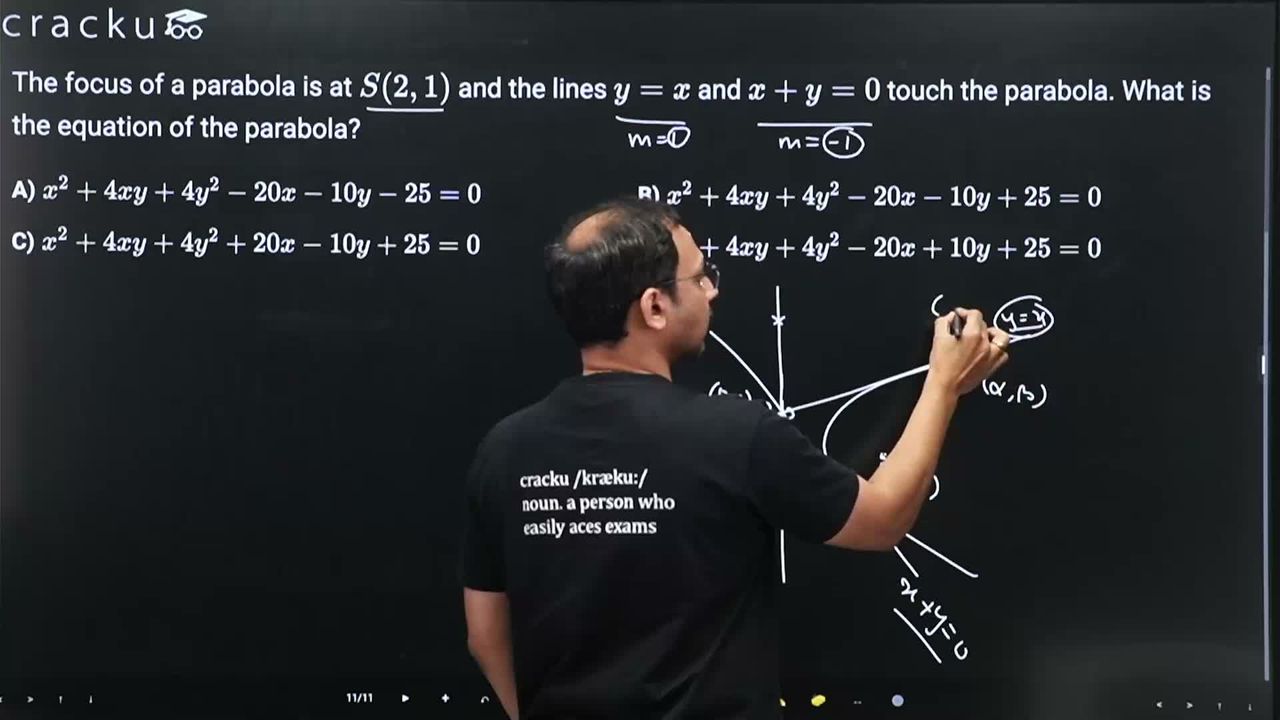
The focus of a parabola is at $$S(2,1)$$ and the lines $$y=x$$ and $$x+y=0$$ touch the parabola. What is the equation of the parabola?
To find the equation of the parabola, we can use the fundamental geometric properties of parabolas concerning tangents and the directrix.
The focus of the parabola is given as $$S(2, 1)$$, and the two given tangents are:
$$L_1: x - y = 0$$
$$L_2: x + y = 0$$
Notice that the two tangents are perpendicular to each other because the product of their slopes is $$(1)(-1) = -1$$.
A standard property of parabolas states that the locus of the intersection of orthogonal (perpendicular) tangents is the directrix of the parabola.
Solving the equations of the two tangents simultaneously:
$$x - y = 0 \implies x = y$$
Substituting into the second equation $$x + y = 0$$ gives $$2x = 0$$, so $$x = 0$$ and $$y = 0$$.
Thus, the intersection point of the perpendicular tangents is $$(0, 0)$$, which must lie on the directrix.
Another key property of a parabola is that the reflection of the focus with respect to any tangent line always lies on the directrix.
Let us find the reflection of the focus $$S(2, 1)$$ with respect to the first tangent $$x - y = 0$$:
$$\frac{x_1 - 2}{1} = \frac{y_1 - 1}{-1} = \frac{-2(2 - 1)}{1^2 + (-1)^2} = \frac{-2(1)}{2} = -1$$
From this, we get a point on the directrix:
$$x_1 - 2 = -1 \implies x_1 = 1$$
$$y_1 - 1 = 1 \implies y_1 = 2$$
So, $$P_1(1, 2)$$ lies on the directrix.
Now, let us find the reflection of the focus $$S(2, 1)$$ with respect to the second tangent $$x + y = 0$$:
$$\frac{x_2 - 2}{1} = \frac{y_2 - 1}{1} = \frac{-2(2 + 1)}{1^2 + 1^2} = \frac{-2(3)}{2} = -3$$
From this, we get a second point on the directrix:
$$x_2 - 2 = -3 \implies x_2 = -1$$
$$y_2 - 1 = -3 \implies y_2 = -2$$
So, $$P_2(-1, -2)$$ also lies on the directrix.
Since the directrix is a straight line passing through the origin $$(0, 0)$$ and the point $$(1, 2)$$, we can find its slope $$m$$:
$$m = \frac{2 - 0}{1 - 0} = 2$$
Thus, the equation of the directrix passing through $$(0, 0)$$ with a slope of $$2$$ is:
$$y = 2x \implies 2x - y = 0$$
A parabola is defined as the locus of a point $$P(x, y)$$ whose distance from the focus $$S(2, 1)$$ is equal to its perpendicular distance from the directrix $$2x - y = 0$$:
$$\sqrt{(x - 2)^2 + (y - 1)^2} = \frac{\vert{}2x - y\vert{}}{\sqrt{2^2 + (-1)^2}}$$
Squaring both sides:
$$(x - 2)^2 + (y - 1)^2 = \frac{(2x - y)^2}{5}$$
$$5 \left[ (x^2 - 4x + 4) + (y^2 - 2y + 1) \right] = 4x^2 - 4xy + y^2$$
$$5x^2 + 5y^2 - 20x - 10y + 25 = 4x^2 - 4xy + y^2$$
Rearranging and combining like terms gives the equation of the parabola:
$$x^2 + 4xy + 4y^2 - 20x - 10y + 25 = 0$$
The correct option is B.
Was this solution helpful?
Click on the Email ☝️ to Watch the Video Solution
Create a FREE account and get:
_1.webp)

Educational materials for JEE preparation

Ask our AI anything

AI can make mistakes. Please verify important information.
AI can make mistakes. Please verify important information.
