
Join Our JEE Preparation Group
Prep with like-minded aspirants; Get access to free daily tests and study material.
Sign in
Please select an account to continue using cracku.in
↓ →
Join Our JEE Preparation Group
Prep with like-minded aspirants; Get access to free daily tests and study material.
In a cuboid of dimension $$2L \times 2L \times L$$, a charge $$q$$ is placed at the centre of the surface $$S$$ having area of $$4L^2$$. The flux through the opposite surface to $$S$$ is given by
We need to find the electric flux through the surface opposite to $$S$$ in a cuboid of dimensions $$2L \times 2L \times L$$, where charge $$q$$ is placed at the centre of surface $$S$$ (the $$2L \times 2L$$ face).
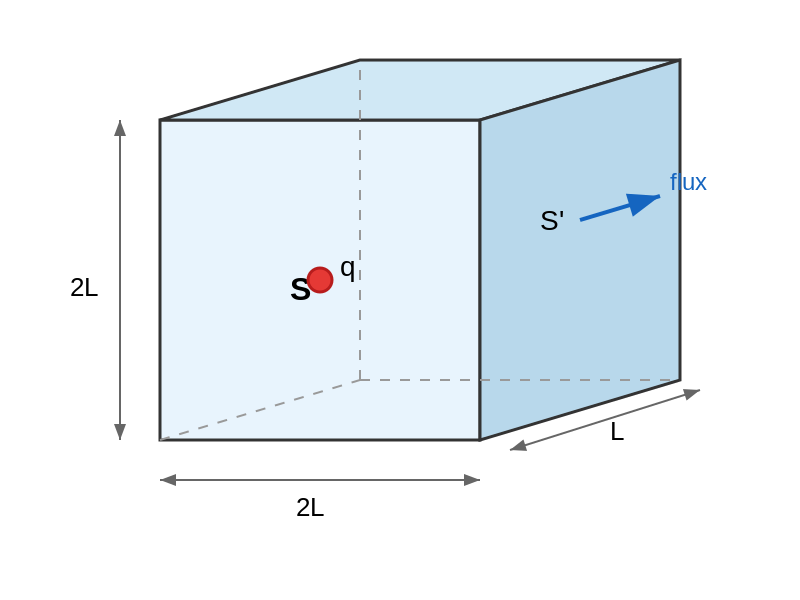
We use the mirror image method. The charge $$q$$ sits at the centre of face $$S$$, and the cuboid extends a distance $$L$$ perpendicular to this face. By placing an identical mirror cuboid on the other side of $$S$$, we form a cube of dimensions $$2L \times 2L \times 2L$$ with $$q$$ at its centre.
By Gauss's Law, the total flux through this cube is $$\frac{q}{\epsilon_0}$$. Since the cube has 6 identical faces and $$q$$ is at the centre, the flux through each face is $$\frac{q}{6\epsilon_0}$$.
Now, the surface opposite to $$S$$ in the original cuboid is exactly one face of the combined cube (the face at distance $$L$$ from the charge along the perpendicular direction). So the flux through it is $$\frac{q}{6\epsilon_0}$$.
Hence, the correct answer is Option D.
Was this solution helpful?
Click on the Email ☝️ to Watch the Video Solution
Create a FREE account and get:
_1.webp)

Educational materials for JEE preparation

Ask our AI anything

AI can make mistakes. Please verify important information.
AI can make mistakes. Please verify important information.
