
Join Our JEE Preparation Group
Prep with like-minded aspirants; Get access to free daily tests and study material.
Sign in
Please select an account to continue using cracku.in
↓ →
Join Our JEE Preparation Group
Prep with like-minded aspirants; Get access to free daily tests and study material.
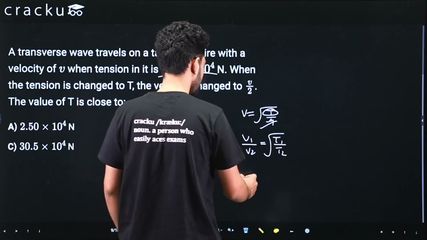
A transverse wave travels on a taut steel wire with a velocity of $$v$$ when tension in it is $$2.06 \times 10^4$$ N. When the tension is changed to T, the velocity changed to $$\frac{v}{2}$$. The value of T is close to:
We begin by recalling the basic formula for the speed of a transverse wave on a stretched string or wire. The speed $$v$$ is given by
$$v=\sqrt{\frac{T}{\mu}}$$
where $$T$$ is the tension in the wire and $$\mu$$ is the linear mass density (mass per unit length) of the wire. Because the physical wire does not change, the value of $$\mu$$ remains the same in every part of the problem.
First, let us write the expression for the initial situation. When the tension is
$$T_1 = 2.06 \times 10^{4}\ \text{N},$$
the corresponding speed is given to be simply $$v$$, so
$$v = \sqrt{\frac{T_1}{\mu}}.$$
Now the tension is altered to a new value $$T_2$$, and under this new tension the speed is reported to become $$\dfrac{v}{2}$$. Therefore we have
$$\frac{v}{2} = \sqrt{\frac{T_2}{\mu}}.$$
Because the same wire is used, $$\mu$$ is identical in both expressions. We can now form a ratio of the two speed formulas in order to eliminate $$\mu$$:
$$\frac{\dfrac{v}{2}}{v} = \frac{\sqrt{\dfrac{T_2}{\mu}}}{\sqrt{\dfrac{T_1}{\mu}}}.$$
Simplifying the left-hand side first, we see that
$$\frac{\dfrac{v}{2}}{v} = \frac{1}{2}.$$
On the right-hand side, the square roots have the same denominator $$\sqrt{\mu}$$, which cancels. We are left with
$$\frac{1}{2} = \sqrt{\frac{T_2}{T_1}}.$$
To remove the square root, we square both sides:
$$\left(\frac{1}{2}\right)^2 = \left(\sqrt{\frac{T_2}{T_1}}\right)^2.$$
Hence,
$$\frac{1}{4} = \frac{T_2}{T_1}.$$
Now we solve for $$T_2$$ by multiplying both sides by $$T_1$$:
$$T_2 = \frac{T_1}{4}.$$
We substitute the numerical value of $$T_1$$:
$$T_2 = \frac{2.06 \times 10^{4}\ \text{N}}{4}.$$
Carrying out the division, we write $$2.06$$ as $$2.06 = 2.060$$ so that the arithmetic is transparent:
$$T_2 = 0.515 \times 10^{4}\ \text{N}.$$
Finally, we shift the decimal point one place to convert $$0.515 \times 10^{4}$$ into standard scientific notation:
$$T_2 = 5.15 \times 10^{3}\ \text{N}.$$
Therefore, the tension that gives a wave speed of $$\dfrac{v}{2}$$ is approximately $$5.15 \times 10^{3}\ \text{N}$$.
Hence, the correct answer is Option B.
Was this solution helpful?
Click on the Email ☝️ to Watch the Video Solution
Create a FREE account and get:
_1.webp)

Educational materials for JEE preparation

Ask our AI anything

AI can make mistakes. Please verify important information.
AI can make mistakes. Please verify important information.


