
Join Our JEE Preparation Group
Prep with like-minded aspirants; Get access to free daily tests and study material.
Sign in
Please select an account to continue using cracku.in
↓ →
Join Our JEE Preparation Group
Prep with like-minded aspirants; Get access to free daily tests and study material.
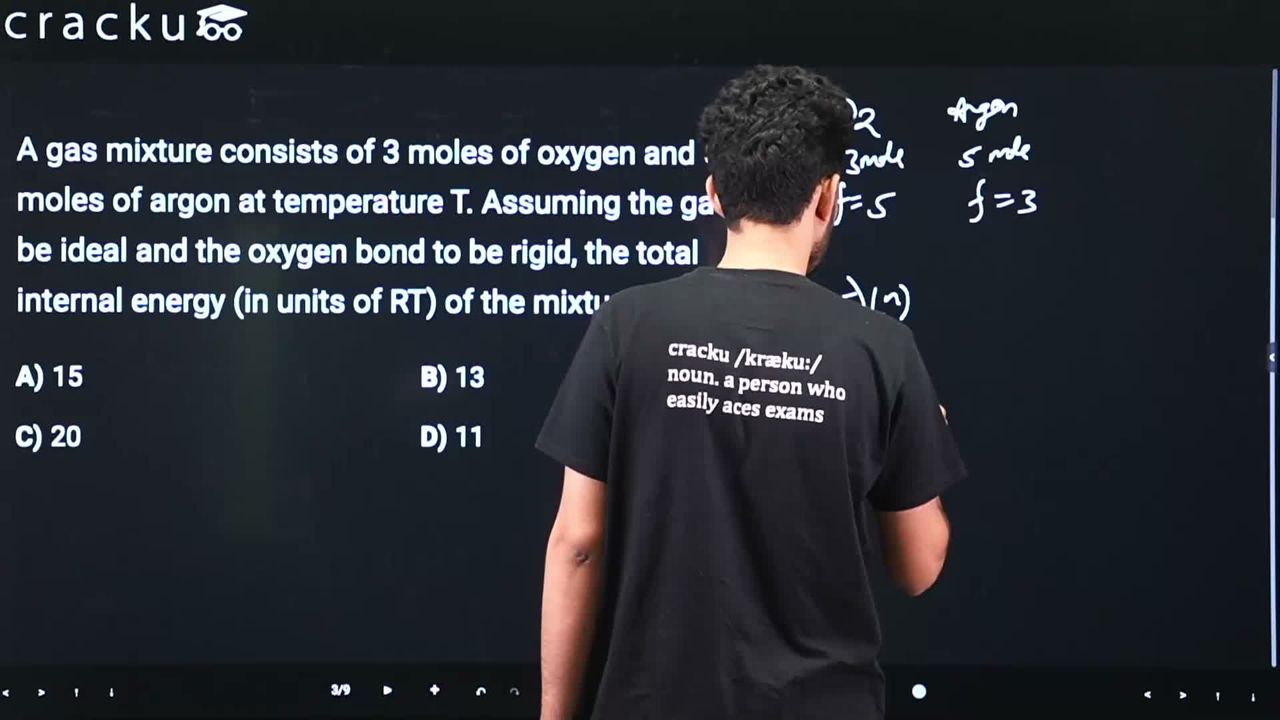
A gas mixture consists of 3 moles of oxygen and 5 moles of argon at temperature T. Assuming the gases to be ideal and the oxygen bond to be rigid, the total internal energy (in units of RT) of the mixture is:
For an ideal gas, we first recall the general formula for the molar internal energy:
$$U = n \left(\frac{f}{2}\right)RT,$$
where $$n$$ is the number of moles, $$f$$ is the number of degrees of freedom of one molecule, $$R$$ is the universal gas constant, and $$T$$ is the absolute temperature. We shall apply this separately to oxygen and argon, then add the two contributions.
Now, consider oxygen. The question explicitly tells us to treat the oxygen bond as rigid, so vibrational motion is not excited. A rigid diatomic molecule possesses:
3 translational degrees of freedom + 2 rotational degrees of freedom $$\;=\;5$$ total degrees of freedom.
Hence, for oxygen $$f_{\text{O}_2} = 5.$$ Substituting this into the energy expression gives
$$U_{\text{O}_2} = n_{\text{O}_2}\left(\frac{f_{\text{O}_2}}{2}\right)RT = 3\left(\frac{5}{2}\right)RT = \frac{15}{2}RT.$$
Next, consider argon. Argon is a mono-atomic gas, and such a particle can move only translationally. Therefore,
$$f_{\text{Ar}} = 3.$$
Using the same formula, we get
$$U_{\text{Ar}} = n_{\text{Ar}}\left(\frac{f_{\text{Ar}}}{2}\right)RT = 5\left(\frac{3}{2}\right)RT = \frac{15}{2}RT.$$
We now add the internal energies of the two components to obtain the total internal energy of the mixture:
$$U_{\text{total}} = U_{\text{O}_2} + U_{\text{Ar}} = \frac{15}{2}RT + \frac{15}{2}RT = \left(\frac{15}{2} + \frac{15}{2}\right)RT = 15\,RT.$$
The question asks for the numerical value in units of $$RT$$, so we divide by $$RT$$:
$$\frac{U_{\text{total}}}{RT} = 15.$$
Hence, the correct answer is Option A.
Click on the Email ☝️ to Watch the Video Solution
Create a FREE account and get:
_1.webp)

Educational materials for JEE preparation

Ask our AI anything

AI can make mistakes. Please verify important information.
AI can make mistakes. Please verify important information.


