
Join Our JEE Preparation Group
Prep with like-minded aspirants; Get access to free daily tests and study material.
Sign in
Please select an account to continue using cracku.in
↓ →
Join Our JEE Preparation Group
Prep with like-minded aspirants; Get access to free daily tests and study material.
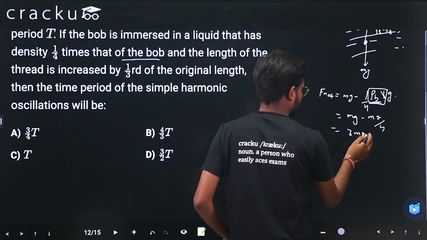
A bob of mass $$m$$ suspended by a thread of length $$\ell$$ undergoes simple harmonic oscillations with time period $$T$$. If the bob is immersed in a liquid that has density $$\frac{1}{4}$$ times that of the bob and the length of the thread is increased by $$\frac{1}{3}$$rd of the original length, then the time period of the simple harmonic oscillations will be:
For a simple pendulum in air, the universally known formula for the time-period is
$$T = 2\pi\sqrt{\dfrac{L}{g}},$$
where $$L$$ is the length of the thread and $$g$$ is the acceleration due to gravity.
Initially we have a thread of length $$L = \ell$$ and, since the pendulum swings in air, the effective acceleration is simply $$g$$. Hence the given time-period is
$$T = 2\pi\sqrt{\dfrac{\ell}{g}} \;. \quad -(1)$$
Now the problem introduces two simultaneous changes:
(i) The bob is completely immersed in a liquid whose density is one-fourth that of the material of the bob.
(ii) The thread length is increased by one-third of its original value.
We analyse the two effects one after the other and then combine them.
Effect of immersion in the liquid
The bob experiences an upward buoyant force equal to the weight of the displaced liquid. If the volume of the bob is $$V$$ and its own density is $$\rho_b$$, then its mass is $$m = \rho_b V$$. The density of the liquid is given to be $$\rho_\ell = \dfrac{1}{4}\rho_b$$.
The buoyant force is therefore
$$F_B = \rho_\ell V g = \frac{1}{4}\rho_b V g = \frac{1}{4} m g.$$
The weight of the bob is $$m g$$ acting downward, so the net downward (restoring) force becomes
$$F_{\text{net}} = m g - \frac{1}{4} m g = \frac{3}{4} m g.$$
This is equivalent to saying that the bob behaves as though the gravitational acceleration were reduced to an effective value
$$g_{\text{eff}} = \frac{3}{4} g \;. \quad -(2)$$
Effect of increasing the length
The new length of the thread after the stated increase is
$$L' = \ell + \frac{1}{3}\ell = \frac{4}{3}\ell \;. \quad -(3)$$
Combining both effects on the time-period
For the new situation the time-period $$T'$$ is again given by the same basic formula but with $$L'$$ and $$g_{\text{eff}}$$:
$$T' = 2\pi\sqrt{\dfrac{L'}{g_{\text{eff}}}}.$$
Substituting the results from (2) and (3) we get
$$T' = 2\pi\sqrt{\dfrac{\dfrac{4}{3}\ell}{\dfrac{3}{4}g}}.$$
We rewrite the fraction inside the square root:
$$\dfrac{\dfrac{4}{3}\ell}{\dfrac{3}{4}g} = \dfrac{4}{3}\ell \times \dfrac{4}{3g} = \dfrac{16}{9}\dfrac{\ell}{g}.$$
Hence
$$T' = 2\pi\sqrt{\dfrac{16}{9}\dfrac{\ell}{g}} = 2\pi\left(\dfrac{4}{3}\right)\sqrt{\dfrac{\ell}{g}}.$$
But from equation (1) we know $$2\pi\sqrt{\dfrac{\ell}{g}} = T$$, so we may write
$$T' = \dfrac{4}{3}T.$$
Therefore the new time-period is four-thirds of the original time-period.
Hence, the correct answer is Option B.
Click on the Email ☝️ to Watch the Video Solution
Create a FREE account and get:
_1.webp)

Educational materials for JEE preparation

Ask our AI anything

AI can make mistakes. Please verify important information.
AI can make mistakes. Please verify important information.


