
Join Our JEE Preparation Group
Prep with like-minded aspirants; Get access to free daily tests and study material.
Sign in
Please select an account to continue using cracku.in
↓ →
Join Our JEE Preparation Group
Prep with like-minded aspirants; Get access to free daily tests and study material.
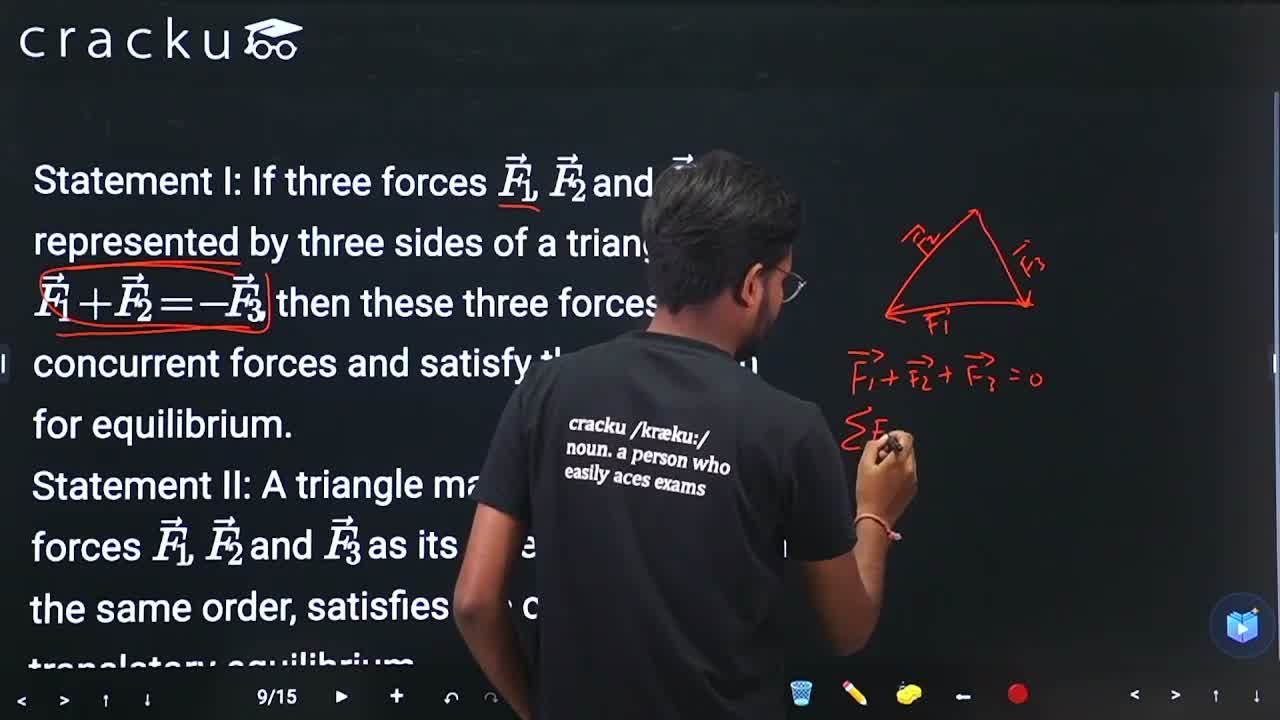
Statement I: If three forces $$\vec{F}_1$$, $$\vec{F}_2$$ and $$\vec{F}_3$$ are represented by three sides of a triangle and $$\vec{F}_1 + \vec{F}_2 = -\vec{F}_3$$, then these three forces are concurrent forces and satisfy the condition for equilibrium.
Statement II: A triangle made up of three forces $$\vec{F}_1$$, $$\vec{F}_2$$ and $$\vec{F}_3$$ as its sides were taken in the same order, satisfies the condition for translatory equilibrium.
In the light of the above statements, choose the most appropriate answer from the options given below:
We have three forces $$\vec F_1$$, $$\vec F_2$$ and $$\vec F_3$$. The statement tells us that these three vectors are represented by the three sides of a triangle and that they are taken in the same cyclic order, i.e. the head of $$\vec F_1$$ is joined to the tail of $$\vec F_2$$, the head of $$\vec F_2$$ is joined to the tail of $$\vec F_3$$ and finally the head of $$\vec F_3$$ returns to the tail of $$\vec F_1$$, thereby closing the triangle.
Whenever three vectors form the three sides of a closed triangle in the same order, we can write, by simple head-to-tail addition, the vector equation
$$\vec F_1 + \vec F_2 + \vec F_3 = \vec 0.$$
Rearranging this equation, we obtain
$$\vec F_1 + \vec F_2 = -\vec F_3.$$
Now, the condition for equilibrium of concurrent forces is that the resultant force must be zero. This condition is expressed algebraically as
$$\vec F_{\text{net}} = \sum \vec F = \vec 0.$$
Comparing this general equilibrium condition with the relation $$\vec F_1 + \vec F_2 + \vec F_3 = \vec 0,$$ we see that the resultant of the three forces vanishes. Hence there is no unbalanced force, so the system is in equilibrium. Since we can imagine these three forces acting at the same point (because only their magnitudes and directions matter for the triangle law), they are described as concurrent forces. Therefore, Statement I is true.
Next, let us examine Statement II. The condition for translatory (translational) equilibrium is exactly the same: the vector sum of all external forces acting on the body must be zero, i.e.
$$\sum \vec F = \vec 0.$$
We have already established that if three forces can be arranged to form a closed triangle in the same order, then
$$\vec F_1 + \vec F_2 + \vec F_3 = \vec 0.$$
This directly satisfies the translational equilibrium condition. No net force means no linear acceleration of the body. Hence Statement II is also true.
Both statements are individually correct, and Statement II is merely a restatement of the vector equilibrium condition without going into the concurrency detail. Consequently, both statements are true.
Hence, the correct answer is Option A.
Was this solution helpful?
Click on the Email ☝️ to Watch the Video Solution
Create a FREE account and get:
_1.webp)

Educational materials for JEE preparation

Ask our AI anything

AI can make mistakes. Please verify important information.
AI can make mistakes. Please verify important information.
