
Join Our JEE Preparation Group
Prep with like-minded aspirants; Get access to free daily tests and study material.
Sign in
Please select an account to continue using cracku.in
↓ →
Join Our JEE Preparation Group
Prep with like-minded aspirants; Get access to free daily tests and study material.
Let z be a complex number such that |z - 6| = 5 and |z + 2 - 6i| = 5. Then the value of $$z^{3}+3z^{2}-15z+141$$ is equal to
We are given the complex number $$z$$ satisfying the two equations $$|z - 6| = 5$$ and $$|z + 2 - 6i| = 5$$, and we wish to find the value of the expression $$z^3 + 3z^2 - 15z + 141$$.
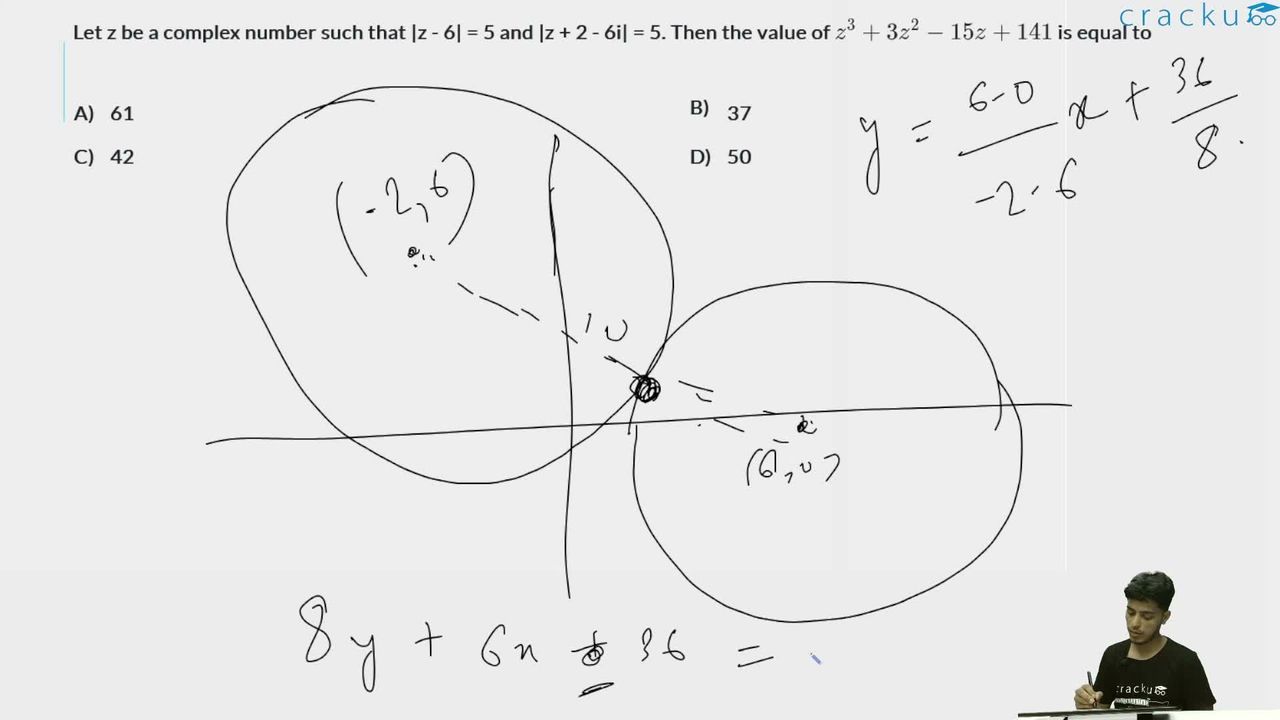
The equation $$|z - 6| = 5$$ represents the circle centered at $$(6,0)$$ with radius 5, while $$|z + 2 - 6i| = 5$$ represents the circle centered at $$(-2,6)$$ with the same radius. Writing $$z = x + iy$$, these become
$$ (x-6)^2 + y^2 = 25, $$
$$ (x+2)^2 + (y-6)^2 = 25. $$
Subtracting the second equation from the first gives
$$ (x-6)^2 - (x+2)^2 + y^2 - (y-6)^2 = 0, $$
which simplifies to
$$ -16x + 12y - 4 = 0, $$
or equivalently
$$ 4x - 3y + 1 = 0 \quad\Longrightarrow\quad x = \frac{3y - 1}{4}. $$
Substituting $$x = \tfrac{3y - 1}{4}$$ into $$(x-6)^2 + y^2 = 25$$ yields
$$ \Bigl(\frac{3y - 1}{4} - 6\Bigr)^2 + y^2 = 25, $$
$$ \Bigl(\frac{3y - 25}{4}\Bigr)^2 + y^2 = 25, $$
$$ \frac{9y^2 - 150y + 625}{16} + y^2 = 25, $$
$$ 9y^2 - 150y + 625 + 16y^2 = 400, $$
$$ 25y^2 - 150y + 225 = 0, $$
$$ y^2 - 6y + 9 = 0, $$
so $$(y - 3)^2 = 0$$ and hence $$y = 3$$. Substituting back gives $$x = \tfrac{3\cdot 3 - 1}{4} = 2$$, and therefore $$z = 2 + 3i$$.
Next we compute
$$ z^2 = (2+3i)^2 = 4 + 12i - 9 = -5 + 12i, $$
$$ z^3 = z\cdot z^2 = (2+3i)(-5+12i) = -10 + 24i - 15i + 36i^2 = -46 + 9i. $$
Finally,
$$ z^3 + 3z^2 - 15z + 141 = (-46+9i) + 3(-5+12i) - 15(2+3i) + 141 $$
$$ = -46 + 9i - 15 + 36i - 30 - 45i + 141 $$
$$ = (-46 - 15 - 30 + 141) + (9 + 36 - 45)i $$
$$ = 50 + 0i = 50. $$
Hence, the value of the expression is 50.
Was this solution helpful?
Click on the Email ☝️ to Watch the Video Solution
Create a FREE account and get:
_1.webp)

Educational materials for JEE preparation

Ask our AI anything

AI can make mistakes. Please verify important information.
AI can make mistakes. Please verify important information.
