
Join Our JEE Preparation Group
Prep with like-minded aspirants; Get access to free daily tests and study material.
Sign in
Please select an account to continue using cracku.in
↓ →
Join Our JEE Preparation Group
Prep with like-minded aspirants; Get access to free daily tests and study material.
Given below are two statements: One is labelled as Assertion (A) and other is labelled as Reason (R)
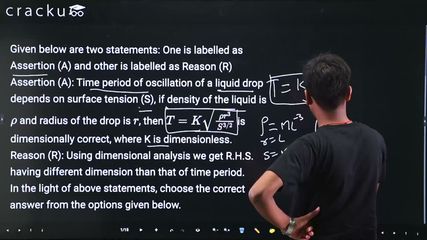
Assertion (A): Time period of oscillation of a liquid drop depends on surface tension (S), if density of the liquid is $$\rho$$ and radius of the drop is $$r$$, then $$T = K\sqrt{\frac{\rho r^3}{S^{3/2}}}$$ is dimensionally correct, where K is dimensionless.
Reason (R): Using dimensional analysis we get R.H.S. having different dimension than that of time period.
In the light of above statements, choose the correct answer from the options given below.
We need to check whether the expression $$T = K\sqrt{\dfrac{\rho r^3}{S^{3/2}}}$$ is dimensionally correct, where $$\rho$$ is density, $$r$$ is radius, $$S$$ is surface tension, and $$K$$ is dimensionless.
The dimensions of each quantity are: density $$[\rho] = ML^{-3}$$, radius $$[r] = L$$, and surface tension $$[S] = MT^{-2}$$ (force per unit length).
Now, the expression inside the square root has dimensions:
$$\dfrac{[\rho][r]^3}{[S]^{3/2}} = \dfrac{ML^{-3} \cdot L^3}{(MT^{-2})^{3/2}} = \dfrac{M}{M^{3/2}T^{-3}} = \dfrac{T^3}{M^{1/2}}$$
Taking the square root: $$\sqrt{\dfrac{T^3}{M^{1/2}}} = \dfrac{T^{3/2}}{M^{1/4}}$$
The dimension of the R.H.S. is $$\dfrac{T^{3/2}}{M^{1/4}}$$, which is NOT equal to $$[T] = T$$.
So, the Assertion (A) is false — the given expression is NOT dimensionally correct.
The Reason (R) states that using dimensional analysis, the R.H.S. has different dimensions than the time period. Since we showed that the R.H.S. has dimensions $$T^{3/2}M^{-1/4}$$ instead of $$T$$, the Reason is true.
Hence, the correct answer is Option D: (A) is false but (R) is true.
Was this solution helpful?
Click on the Email ☝️ to Watch the Video Solution
Create a FREE account and get:
_1.webp)

Educational materials for JEE preparation

Ask our AI anything

AI can make mistakes. Please verify important information.
AI can make mistakes. Please verify important information.
