
Join Our JEE Preparation Group
Prep with like-minded aspirants; Get access to free daily tests and study material.
Sign in
Please select an account to continue using cracku.in
↓ →
Join Our JEE Preparation Group
Prep with like-minded aspirants; Get access to free daily tests and study material.
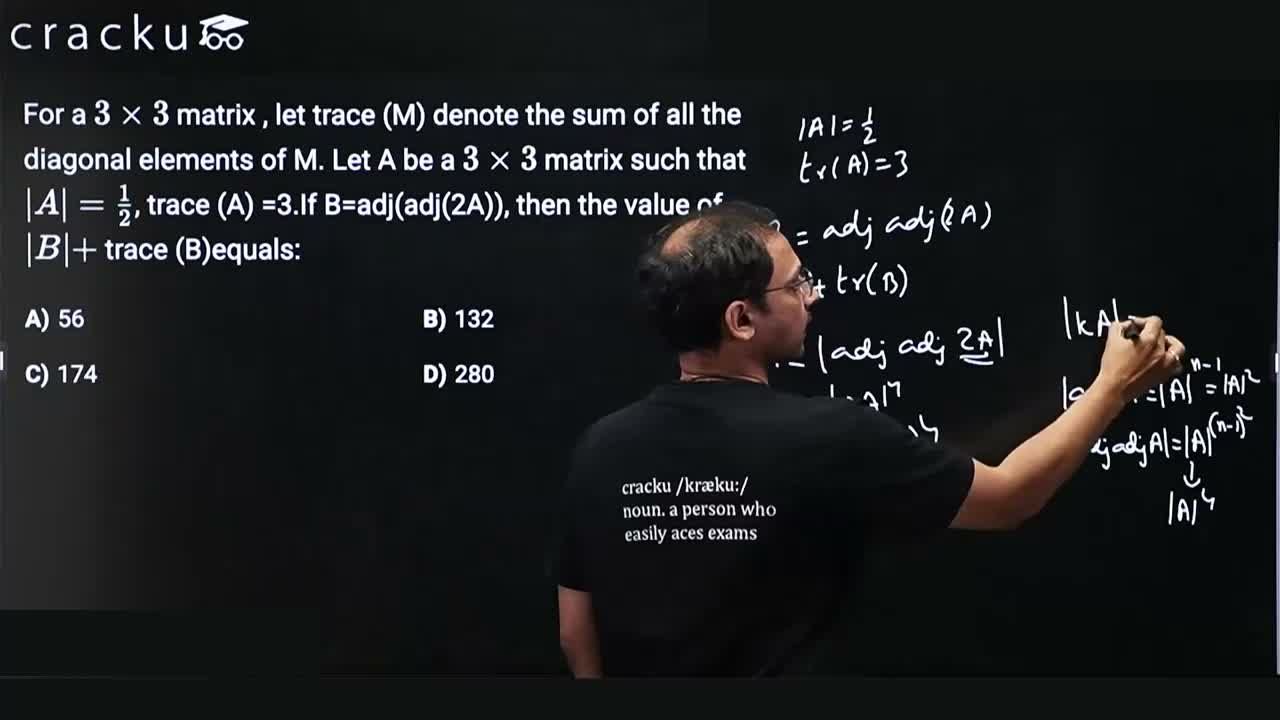
For a $$3\times 3$$ matrix , let trace (M) denote the sum of all the diagonal elements of M. Let A be a $$3\times 3$$ matrix such that $$|A|=\frac{1}{2}$$, trace (A) =3.If B=adj(adj(2A)), then the value of $$|B|+$$ trace (B)equals:
Given a 3×3 matrix A with determinant |A| = 1/2 and trace(A) = 3. We need to find B = adj(adj(2A)) and then compute |B| + trace(B).
Recall the properties for n×n matrices (here n=3):
Start by computing |2A|:
$$|2A| = 2^3 |A| = 8 \times \frac{1}{2} = 4$$
Now compute adj(2A):
$$\text{adj}(2A) = 2^{3-1} \text{adj}(A) = 2^2 \text{adj}(A) = 4 \text{adj}(A)$$
Next, compute adj(adj(2A)) = adj(4 adj(A)):
$$\text{adj}(4 \text{adj}(A)) = 4^{3-1} \text{adj}(\text{adj}(A)) = 4^2 \text{adj}(\text{adj}(A)) = 16 \text{adj}(\text{adj}(A))$$
Thus, B = 16 adj(adj(A)).
Since A is invertible (|A| ≠ 0), apply the identity adj(adj A) = |A|n-2 A:
$$\text{adj}(\text{adj}(A)) = |A|^{3-2} A = \left(\frac{1}{2}\right)^1 A = \frac{1}{2} A$$
Substitute back:
$$B = 16 \times \frac{1}{2} A = 8A$$
Now compute |B|:
$$|B| = |8A| = 8^3 |A| = 512 \times \frac{1}{2} = 256$$
Compute trace(B):
$$\text{trace}(B) = \text{trace}(8A) = 8 \times \text{trace}(A) = 8 \times 3 = 24$$
Finally, add |B| and trace(B):
$$|B| + \text{trace}(B) = 256 + 24 = 280$$
The value is 280, which corresponds to option D.
Was this solution helpful?
Click on the Email ☝️ to Watch the Video Solution
Create a FREE account and get:
_1.webp)

Educational materials for JEE preparation

Ask our AI anything

AI can make mistakes. Please verify important information.
AI can make mistakes. Please verify important information.
